Moz DA vs Ahrefs DR: SEO Authority Guide
supawriter
If you’ve ever compared two websites and seen Ahrefs DR say one thing while Moz DA says something totally different, you’re not alone. DR and DA are both popular “authority” metrics, but they’re built differently and they’re useful for different decisions.
This guide breaks down Ahrefs DR vs Moz DA in practical terms so you can evaluate a domain, qualify a link prospect, and report progress without overpromising. If you’re building a content engine around SEO, Supawriter helps you turn these insights into consistent, keyword-targeted publishing with built-in optimization and workflow.
Ahrefs DR vs Moz DA: what’s the difference?
What Ahrefs DR measures (in plain English)
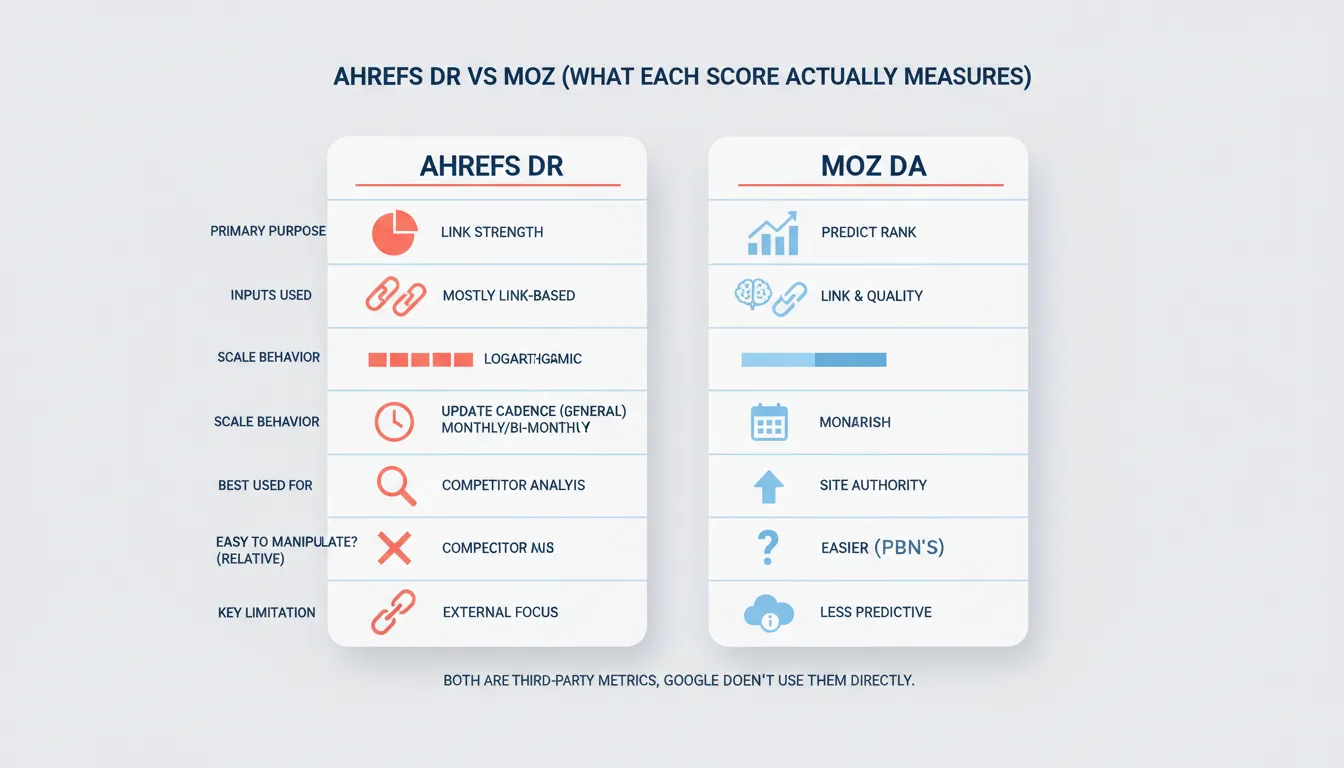
Ahrefs Domain Rating (DR) is a 0–100 score that represents the strength of a website’s backlink profile compared to other sites in Ahrefs’ database. Ahrefs describes DR as a relative metric based on links between websites, scaled into a 0–100 range. In other words, DR is mainly a link popularity and link equity style metric, not a full “SEO score.” (Ahrefs DR definition)
The practical takeaway: DR is usually most useful for link building because it’s designed to compare domains’ backlink strength.
What Moz DA measures (in plain English)
Moz Domain Authority (DA) is also a 1–100 score, but Moz positions it as a predictive ranking score, a way to estimate how likely a website is to perform in search relative to competitors. Moz notes that DA is comparative, not a direct Google ranking factor, and it’s computed from Moz’s own link index and multiple signals. (Moz DA overview)
The practical takeaway: DA is often used for benchmarking and “how strong is this domain in my space?” conversations, but it still needs to be backed up with other checks.
Why the numbers don’t match across tools
DR and DA can disagree for three big reasons:
- Different link indexes: Ahrefs and Moz crawl the web differently, so they don’t “see” the same links.
- Different scoring systems: DR is explicitly about backlink profile strength and how link equity is distributed, while DA is a broader predictive model.
- Different scaling: both are relative, and relative metrics can move even when your site doesn’t change, because the rest of the web changes.
This is why treating DR or DA like a universal truth can lead to bad calls. SISTRIX makes the point plainly: these are proprietary metrics based on third-party indexes, so they can drift from what Google sees and can vary across tools. (SISTRIX critique of authority metrics)
How DR and DA are calculated (and what that implies)
Ahrefs DR calculation logic: link equity and outgoing links
Ahrefs explains that DR is calculated by looking at links between domains, and that a linking domain splits its influence among the domains it links to. That means a link from a strong domain that links out to relatively few unique domains can matter more than a link from an even stronger domain that links to tons of sites. (How Ahrefs describes DR calculation)
Implication: DR can move quickly when you add new quality referring domains. It can also go up in ways that don’t translate to rankings if the links are irrelevant, low-quality, or not backed by real organic performance.
Moz DA calculation logic: predictive score and link index
Moz frames DA as a ranking prediction metric computed using Link Explorer data and multiple factors. It’s meant for comparison, not as a KPI you chase blindly. (Moz DA overview)
Implication: DA may change when Moz updates its model or when competitors change. In some niches it can move slowly, which is why DA alone isn’t a great “quality” filter.
Logarithmic scaling: why gains get harder at the top
Ahrefs states DR is on a logarithmic 0–100 scale, meaning moving from (for example) 70 to 71 is typically much harder than moving from 20 to 21. (Ahrefs glossary DR description)
Implication: if you’re already strong, judge progress more by outcomes (qualified traffic, leads, rankings for target queries) than by trying to force a DR or DA increase.
When to use DR vs DA for real SEO work
Link prospecting and outreach qualification
If you’re choosing websites for outreach, sponsored placements, partnerships, or digital PR shortlists, DR is a solid first-pass filter because it focuses on backlink profile strength.
A practical way to use DR:
- Start with a DR range that fits your current level, and avoid only chasing top-tier sites.
- Then validate with topical relevance, the site’s real organic presence, editorial standards, and whether they link out responsibly.
A practical way to use DA:
- Use DA as a second opinion for “domain strength” in your niche, especially when you’re comparing similar publishers.
Competitive benchmarking and gap analysis
For competitive analysis, DA is often easier to communicate because it’s positioned as a comparative “ability to rank” score. Still, you’ll get a more reliable picture if you benchmark multiple signals:
- DR and DA (domain-level context)
- Page-level signals (the pages that actually rank)
- Organic visibility trends (is the site growing?)
- Topical match (are they consistently strong in your specific topic?)
If you’re building an editorial roadmap from those findings, Supawriter can help you turn it into an actual workflow with keyword targeting, on-page SEO structure, and a schedule your team can stick to.
You may also find these helpful as you connect authority metrics back to content work:
Reporting to stakeholders without misleading them
The safest way to report DR/DA is:
- Treat them as directional indicators
- Pair them with outcomes (rankings, qualified clicks, demos, signups)
- Explain that Google ranks pages, and these metrics are third-party estimates
A simple line that keeps you honest: “DR/DA improved, which usually reflects stronger link equity, and we’re also seeing movement in rankings and organic leads.”
Best tools to check and track authority metrics (2026)
Supawriter
Supawriter is an AI-powered content engine designed to help you publish SEO content at scale while staying on-brand. DR and DA are useful signals, but most teams get results by executing consistently: producing content that earns links over time, targeting realistic keywords, and publishing on a schedule.
Key features:
- Long-form AI writing that supports 2,500+ word posts with brand voice consistency
- SEO optimization including keyword targeting and metadata support
- Smart scheduling and content calendar generation
- Content suggestions for high-opportunity topics
- Contextual visuals and AI image creation for richer pages
- CMS and publishing workflow, with deployment to any website
Pros:
- Strong for teams that need repeatable production quality and speed
- Turns authority metric insights into a publishing system
Cons:
- Not a replacement for a dedicated backlink index if you need deep link auditing
Best for:
SaaS founders and B2B marketing teams that want an SEO engine, not just dashboards.
Pricing:
Pricing varies by plan and usage, so check Supawriter directly for current details.
Ahrefs
Ahrefs is one of the best-known toolsets for backlink research, and it’s the source of DR.
Key features:
- Domain Rating (DR) and URL Rating (UR)
- Backlink discovery, referring domains, and competitor link analysis
- Prospecting and link intersect-style workflows (depending on plan/features)
Pros:
- DR is clearly documented and widely used for link prospecting
- Strong for link-centric analysis and competitor backlink research
Cons:
- DR can turn into a vanity metric if you don’t pair it with relevance and traffic checks
Best for:
SEO teams running consistent link building and needing a large link dataset.
Pricing:
Ahrefs pricing changes over time; verify current tiers on Ahrefs.
Moz
Moz is the original source of Domain Authority and provides a broader SEO suite.
Key features:
- Domain Authority (DA) and Link Explorer data
- Competitive and site SEO tooling (varies by product)
Pros:
- DA is easy to explain for benchmarking and stakeholder conversations
- Helpful ecosystem for learning and standard SEO workflows
Cons:
- Like all authority metrics, DA can distract teams from page-level ranking work
Best for:
Teams that want DA benchmarking plus a general SEO platform.
Pricing:
Moz pricing varies by plan; verify current tiers on Moz.
Semrush
Semrush is often used as an all-in-one SEO and competitive research suite, and many teams use it alongside DR/DA even if they primarily reference those two metrics.
Key features:
- Competitive research, keyword workflows, and site auditing (varies by plan)
- Authority-style metrics (Semrush uses its own)
Pros:
- Strong breadth across SEO tasks beyond backlinks
Cons:
- Tool sprawl is easy, you still need a clear workflow for decisions
Best for:
Marketing teams that want keyword research and competitive intel alongside SEO execution.
Pricing:
Semrush pricing varies by plan; verify current tiers on Semrush.
Common misconceptions and a safer workflow
Myth: higher DR/DA guarantees rankings
A higher DR or DA can be a helpful sign that a domain has built up stronger links, but it doesn’t guarantee that your page will rank.
What tends to matter more day-to-day:
- Search intent match
- Content depth and usefulness
- Page-level links and internal linking
- Technical health
- Competitive SERP reality
If you want a practical system for turning SERP observations into pages that actually ship, build a content strategy step by step and tie it to a publishing cadence.
How to spot manipulated DR/DA signals
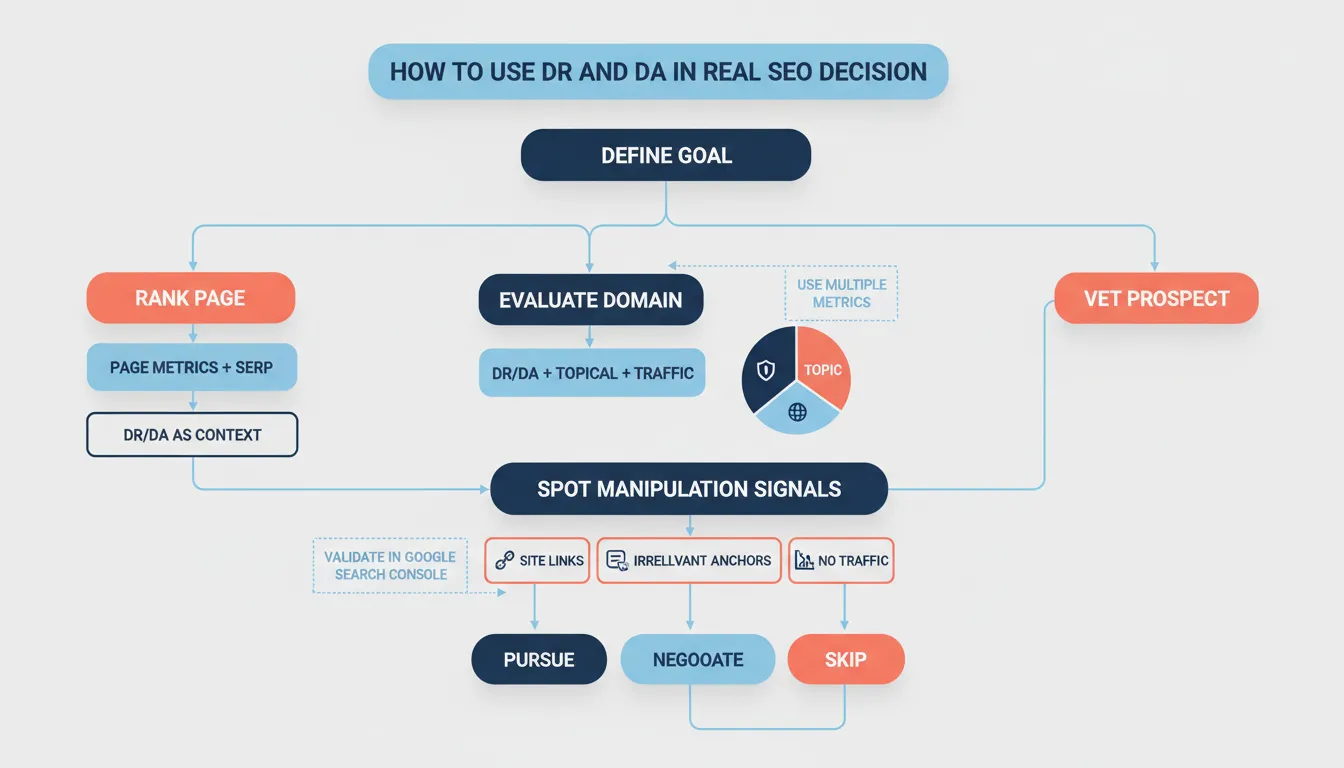
When a domain looks “strong” by DR/DA but feels off, watch for:
- Off-topic link profiles (lots of links unrelated to the site’s niche)
- Thin content across the site
- Obvious sitewide footer/sidebar links
- Little to no organic traffic footprint despite a high authority score
Remember SISTRIX’s warning: these metrics are derived from third-party link indices and can lead to wrong decisions if you treat them as the decision-maker instead of a clue. (SISTRIX critique)
A simple checklist for choosing link opportunities
Use this quick workflow when evaluating a link prospect:
- Step 1: Check DR and DA (get a quick strength read)
- Step 2: Confirm topical relevance (would a human expect this site to mention yours?)
- Step 3: Validate organic reality (does the site rank for anything meaningful?)
- Step 4: Inspect link quality signals (editorial standards, outbound linking patterns)
- Step 5: Decide what you’re trying to get: referral traffic, brand trust, link equity, or some mix
At the end of the day, DR and DA are most valuable when they support a repeatable SEO machine: publish content worth ranking, earn links naturally, and keep your team shipping. If you want that system with built-in SEO optimization, visuals, scheduling, and publishing workflows, explore how Supawriter can help you turn authority metrics into consistent organic growth.
Grow your traffic on autopilot now
Join thousands of users already using our platform.