How to Grow Organic Traffic in 2026: 12 Proven Strategies
supawriter
Growing organic traffic is not about “doing more SEO.” It’s about building a repeatable system that turns search demand into pages that rank, earn clicks, and convert.
If you’re trying to grow organic traffic in 2026, you’re dealing with tougher SERPs, more competitors publishing faster, and higher expectations for content quality and page experience. That’s why teams lean on platforms like Supawriter: you get consistent, SEO-optimized content production without losing your brand voice or your publishing cadence.
Below is a practical framework and 12 strategies you can apply whether you’re a solo founder, a growth marketer, or an SEO lead.
What “organic traffic” means in 2026 (and what changed)
Organic traffic is visits that come from unpaid search results, typically Google, but also Bing and others. You earn it by ranking for queries your audience searches, then winning the click with a clear snippet and a page people trust.
Organic vs paid vs referral traffic
You’ll usually see your traffic grouped like this:
- Organic search: clicks from non-ad search results
- Paid search: ad clicks (Google Ads, etc.)
- Referral: clicks from other websites linking to you
- Direct: typed URL, bookmarks, “unknown” sources
- Social: clicks from social platforms
Organic is the channel that compounds because a good page can bring in traffic for months or years after you publish.
Why ranking isn’t enough anymore (CTR and SERP features)
Modern SERPs are crowded with ads, featured snippets, “People also ask,” video carousels, and more. You can rank and still underperform if your title, snippet, or page format doesn’t match what the searcher wants.
A useful reality check: in Backlinko’s analysis of Google CTR, the #1 organic result gets about 27.6% of all clicks, and the top 3 results capture over half of clicks. That’s why moving from position 6 to 3 often matters more than publishing 20 new posts. (Backlinko CTR study)
Set expectations: timelines and compounding results
Most sites see meaningful movement on:
- Quick wins (2 to 6 weeks): titles, internal links, content refreshes, fixing indexation issues
- Growth wins (2 to 6 months): topic clusters, authority building, better UX
- Compounding wins (6 to 12+ months): brand demand, strong backlink profile, multiple clusters dominating a niche
If your site is new, assume the first 60 to 90 days are about building a foundation and publishing consistently.
The 2026 framework to grow organic traffic
Organic traffic growth works best as a loop, not a checklist.
Step 1: measure baseline in Google Search Console and GA4
Start with Google Search Console (GSC). It tells you what’s actually happening in Google search.
Baseline metrics to capture today:
- Total clicks and impressions (last 28 days)
- Average position (directional, not absolute truth)
- CTR by top queries
- Top pages by clicks
- Pages with high impressions but low CTR (easy wins)
Then open GA4 to connect traffic to outcomes:
- Organic sessions
- Conversions (demo requests, trials, purchases)
- Engagement (time, scroll proxies, key events)
Step 2: remove technical blockers to crawling, indexing, and speed
Your content won’t rank consistently if Google struggles to crawl or understand your site.
Prioritize:
- Indexation: pages you want indexed should not be blocked by robots/noindex
- Canonicals: avoid duplicates and mixed signals
- Internal crawl paths: important pages should be reachable in a few clicks
- Performance: fix slow templates, oversized images, script bloat
Google’s own guidance emphasizes creating helpful, reliable, people-first content, which also means a site experience that lets users actually consume that content. (Google Search Central)
Step 3: build topic clusters and publish consistently
Most SERP winners don’t publish random posts. They build clusters:
- A pillar page targeting a broader topic
- Multiple supporting pages targeting long-tail angles
- Strong internal links that connect the cluster
If you want consistency without turning your team into a content factory, this is where Supawriter fits naturally: it supports long-form writing, SEO optimization, smart scheduling, and publishing workflows so you can keep a steady output while maintaining quality.
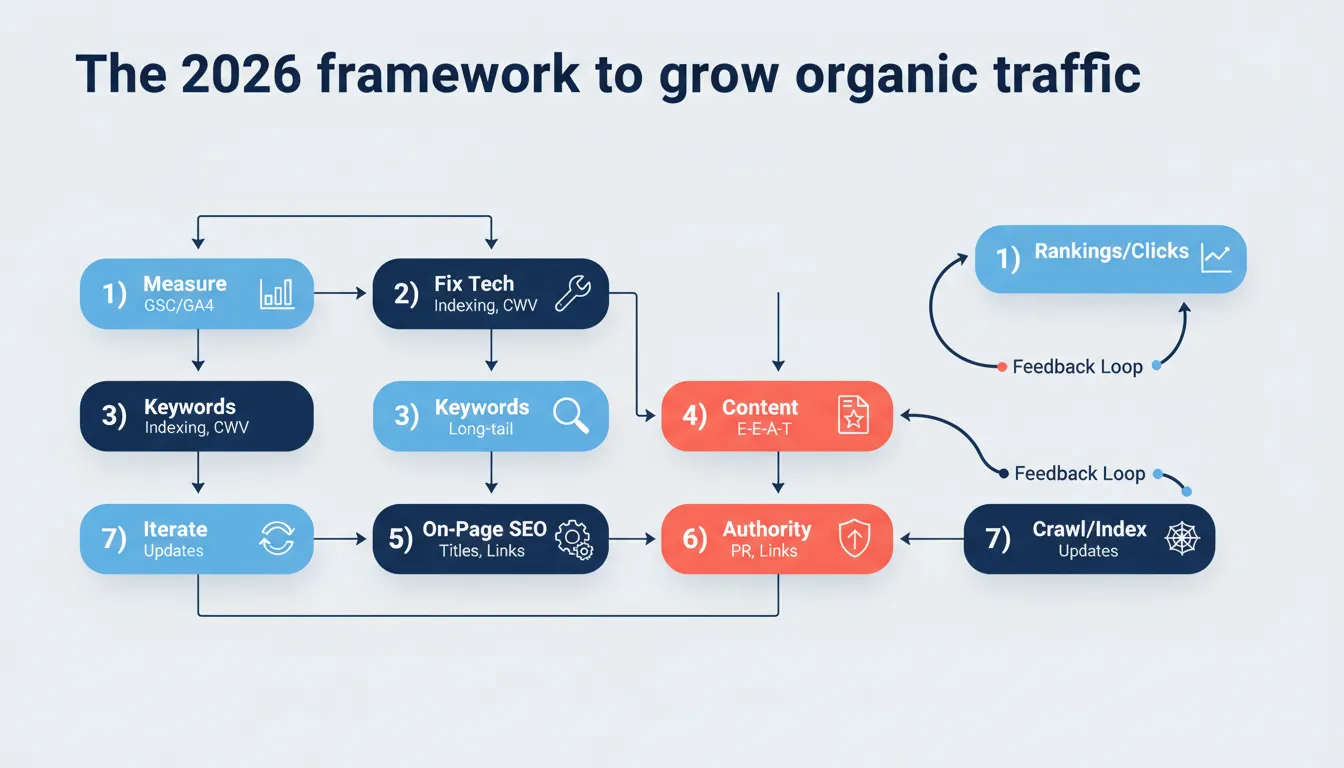
12 proven strategies to increase organic traffic (prioritized)
These strategies are ordered roughly by “most reliable first,” especially for small and mid-sized sites.
Before the list, use this decision rule:
- If you have impressions but low clicks: improve CTR and on-page relevance.
- If you have good content but can’t rank: fix internal linking and authority.
- If you have rankings but no leads: align intent and improve conversion paths.
Quick wins (weeks)
1) Refresh pages that are decaying
Content refreshes are often the fastest way to grow organic traffic because the page already has history, links, and some trust.
Do this in GSC:
- Filter to a page
- Compare last 28 days vs previous 28 days
- Look for queries where position dropped or CTR fell
Refresh checklist:
- Update screenshots, steps, and dates
- Add missing subtopics from “People also ask”
- Improve title tag for intent and clarity
- Add 2 to 5 internal links from related pages
2) Rewrite title tags to win the click
Your title is your organic ad.
A practical formula that works across many “how to” SERPs:
- Primary keyword + outcome + year
Examples:
- “Grow Organic Traffic: 12 Strategies for 2026”
- “Grow Organic Traffic for SaaS: Framework and Checklist (2026)”
Aim for titles that are readable, not stuffed. Many SEO guides recommend keeping title tags around 50 to 60 characters, but clarity matters more than a perfect count.
3) Add internal links like you’re building a map
Internal links do three jobs:
- Help Google discover and understand your site structure
- Pass relevance and authority to important pages
- Help users move to the next step
Make it systematic:
- Every new post links to 2 to 5 related posts
- Every supporting post links back to its pillar
- Update older posts quarterly to link to your newer, better content
If you want a deeper on-page workflow, use this internal guide: On-page SEO checklist for 2026.
4) Match the page type to the search intent
A common reason organic traffic stalls is publishing the wrong format.
Examples:
- “best X” usually wants a listicle/comparison
- “how to X” usually wants a step-by-step guide
- “X vs Y” wants a comparison page
- “pricing” is often navigational or commercial and needs a tight answer
When intent is mixed, answer the primary intent first, then cover the secondary questions.
5) Fix indexation and technical SEO issues that block growth
If your important pages aren’t indexed, you can publish forever and still not grow.
Check:
- Coverage and indexing reports in GSC
- XML sitemap accuracy
- Canonicals and duplicates
- Redirect chains
- Broken internal links
Semrush’s organic traffic guide also starts with fixing technical issues before scaling content, which matches what most sites see in practice. (Semrush organic traffic guide)
6) Target featured snippets and “People also ask” expansions
Featured snippets can raise CTR even if your ranking doesn’t move much.
Tactics:
- Add a 40 to 60 word definition near the top
- Use short step lists and clear subheadings
- Add an FAQ section where appropriate
This works best for informational queries where Google is already showing snippet-like features.
Growth plays (months)
7) Build topic clusters that earn multiple rankings, not one
A single post is fragile. A cluster holds up better.
Cluster plan:
- Choose 1 pillar topic closely tied to your product
- Create 6 to 12 supporting posts targeting long-tail keywords
- Interlink intentionally
- Refresh the pillar every quarter
If you need help structuring this, see: how to build a content strategy step by step in 2026.
8) Publish consistently with a real content calendar
Consistency matters, but the bigger win is that it forces you to create enough surface area to rank.
A simple calendar should include:
- Keyword and intent
- Target page type
- Primary conversion goal
- Internal links to add
- Update date (yes, plan updates when you publish)
This is where Supawriter can remove a major bottleneck: it helps you go from keyword to publish-ready content with scheduling and a workflow, so the calendar turns into output instead of a spreadsheet.
9) Create one linkable asset per cluster
Links still matter, but cold-link outreach is unpredictable.
Instead, create something people actually cite:
- Original data (even a small dataset)
- A benchmark report
- A free template
- A calculator
- A clear comparison framework
Then do targeted outreach to:
- partners
- newsletters
- communities
- bloggers covering the space
10) Improve UX so engagement supports rankings and conversions
UX doesn’t replace relevance, but it can help good content perform better.
Quick UX upgrades:
- Make the first screen answer the query fast
- Add jump links only if the page is very long
- Compress images and reduce layout shift
- Keep paragraphs short and easy to scan
Moats (quarters)
11) Build tools, calculators, and templates to capture demand
Some SERPs reward interactive resources because they answer the query better than a generic post.
Examples:
- “ROI calculator”
- “email subject line generator”
- “SEO content brief template”
If you do this, support the tool with a strong explanatory page so it can rank.
12) Grow branded search demand by becoming the obvious answer
When people search your brand name plus a category, you usually win easier clicks.
How to build brand demand:
- Publish definitive content clusters
- Show real experience (screenshots, workflows, examples)
- Earn mentions through partnerships and community participation
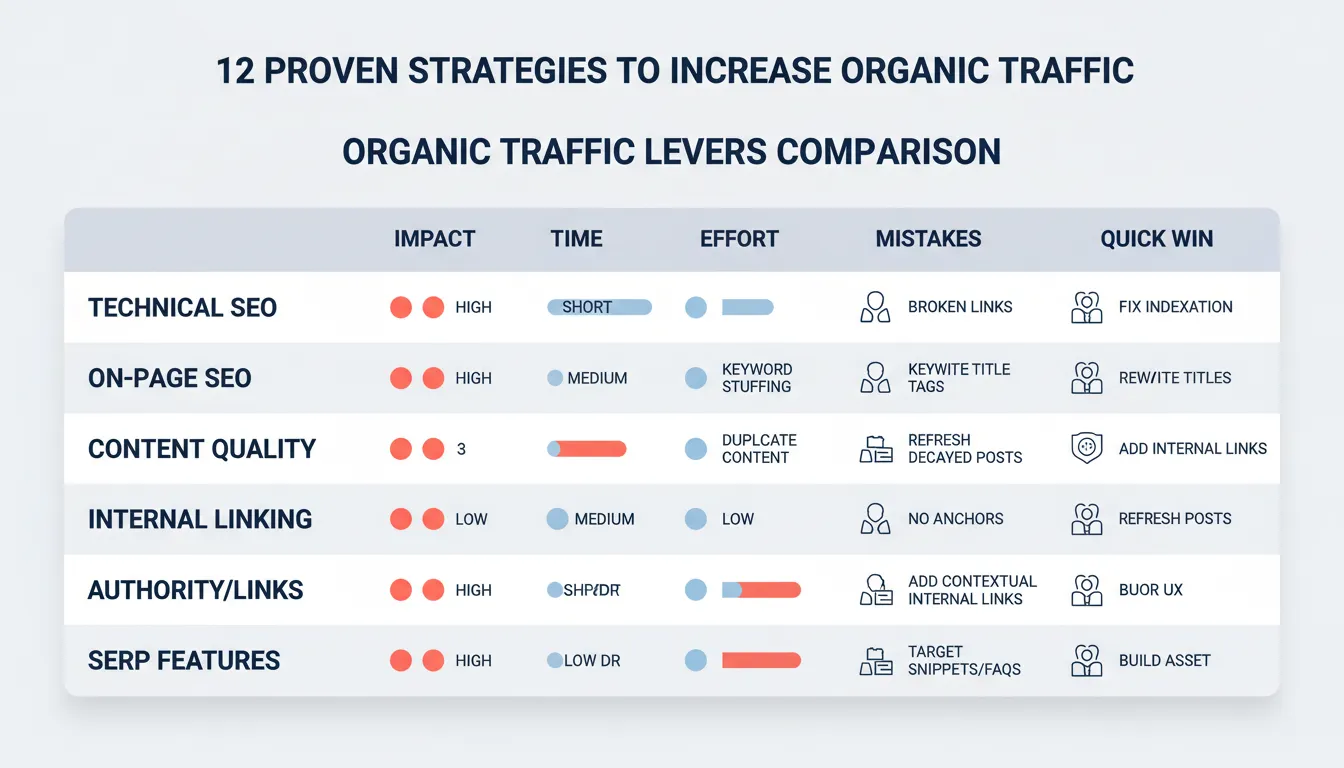
Strategy picker table (impact vs time)
Use this to choose what to do next.
| Lever | Best for | Time to results | Effort | Example quick win |
|---|---|---|---|---|
| Content refresh | Sites with existing posts | 2 to 6 weeks | Medium | Update decayed posts and re-submit in GSC |
| Internal linking | Any site with 20+ pages | 1 to 4 weeks | Low | Add 3 contextual links into top pages |
| On-page SEO | Pages with impressions | 1 to 4 weeks | Low | Rewrite title tag and tighten the opening |
| Technical SEO | Sites with indexing issues | 1 to 8 weeks | Medium | Fix noindex, canonicals, sitemap |
| Topic clusters | Sustainable growth | 2 to 6 months | High | Publish pillar and 4 supports |
| Linkable assets | Competitive SERPs | 2 to 6 months | High | Publish a template or benchmark report |
How to measure organic traffic growth without fooling yourself
If you don’t measure correctly, you’ll either panic too early or celebrate noise.
Traffic KPIs that matter: clicks, impressions, CTR, conversions
Track these weekly:
- Clicks (GSC): real organic traffic from Google search
- Impressions (GSC): visibility, an early signal before clicks
- CTR (GSC): snippet performance and intent match
- Conversions (GA4): business outcomes
If impressions go up but clicks don’t, you likely need better CTR or better alignment to intent.
Build a simple reporting dashboard and review rhythm
A lightweight cadence that works:
- Weekly (30 minutes): top gaining pages, top losing pages
- Monthly (60 to 90 minutes): cluster progress, content updates planned
- Quarterly: prune or consolidate thin/overlapping content
Common pitfalls: seasonality, cannibalization, tracking errors
Watch for:
- Seasonality: compare year-over-year when you can
- Cannibalization: two pages competing for the same query
- Tracking gaps: GA4 misconfigured events; GSC not verified for all variants
If you suspect cannibalization, merge the weaker page into the stronger one and redirect.
A simple 30-60-90 day plan (with an automation option)
Here’s a plan you can execute without a huge team.
Days 1-30: audit, fix, refresh, and internal link
- Export top pages and queries from GSC
- Refresh 5 to 10 posts with declining clicks
- Fix indexing blockers
- Add internal links pointing to your money pages
Supporting read: what SEO content is and how to create it in 2026.
Days 31-60: publish cluster content and build 1 linkable asset
- Pick one pillar topic
- Publish the pillar plus 3 to 5 supporting posts
- Create one linkable asset (template, benchmark, tool)
- Do outreach to 20 to 50 highly relevant prospects
Days 61-90: scale content velocity and iterate with updates
- Publish 2 to 4 posts per week if you can sustain quality
- Update internal links across the cluster
- Re-check CTR and titles for pages with high impressions
- Start a second cluster if the first is stable
If you want this to be easier to maintain, Supawriter is built for this workflow: consistent long-form content, SEO optimization, smart scheduling, and publishing support so you can keep momentum without constant context-switching.
Organic traffic growth is a long game, but it doesn’t have to be chaotic. Build the loop, publish consistently, update what you ship, and measure like an operator. When you’re ready to turn that into a steady content engine, explore Supawriter and make “grow organic traffic” something your team does on schedule, not only when there’s time.
Grow your traffic on autopilot now
Join thousands of users already using our platform.