2026 Link Building: 10 Ways to Earn Backlinks
supawriter
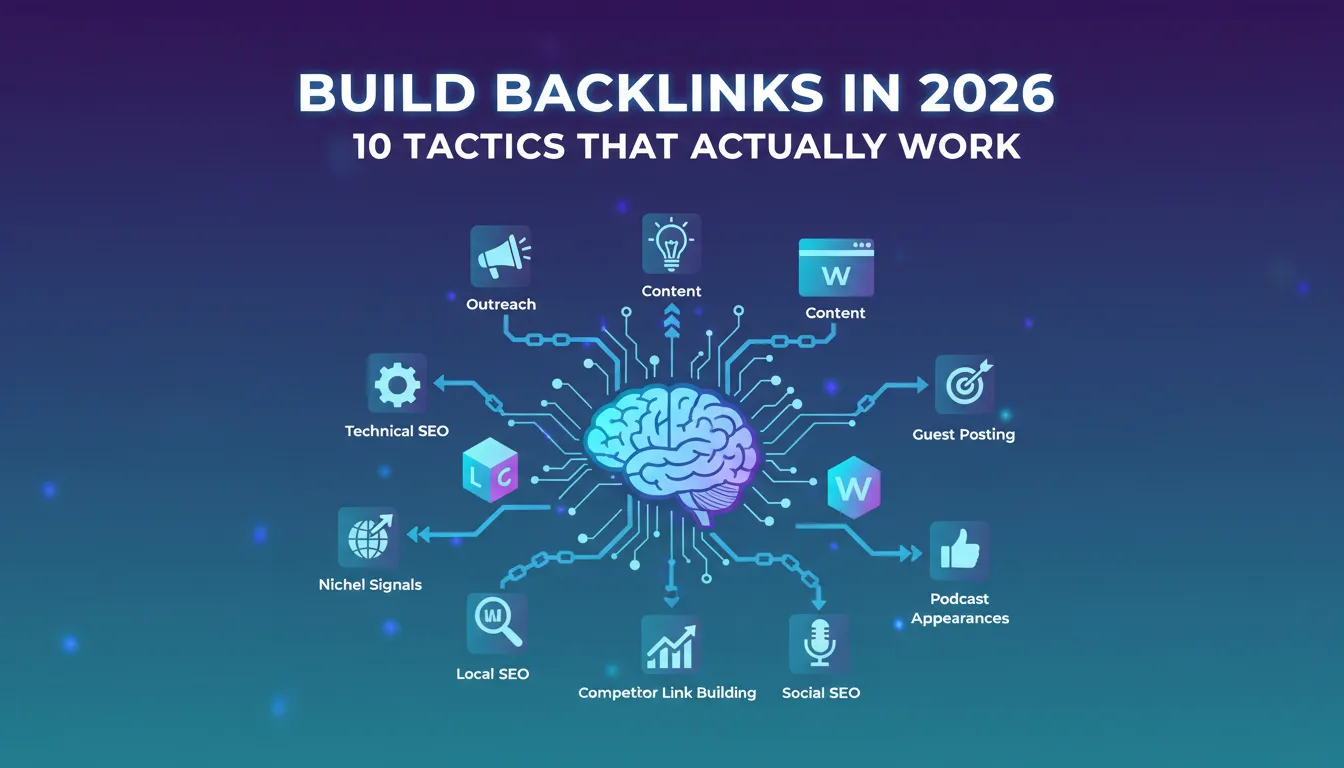
Building backlinks is still one of the fastest ways to improve rankings, but it is also one of the easiest places to waste time, or get into trouble, if you chase “easy links” instead of earning the right links.
In 2026, the teams that win do three things consistently: they pick the right pages to promote, they create something worth citing, and they run outreach like a system. You can do that without turning link building into a bloated process with Supawriter, because you can turn research into linkable assets, keep a publishing cadence, and ship updates quickly when opportunities come up.
A 2026-ready backlink strategy (before you start outreach)
Pick one page to build links to (not your homepage)
If you try to build backlinks to everything, you will build backlinks to nothing.
Start by choosing one target URL for the next 30 days:
- A “money” page (product, category, service)
- A comparison page (for SaaS, these convert well)
- A high-intent guide that naturally supports your product
Then decide the supporting pages (2 to 4 articles) that internally link into that target. This makes every new backlink more valuable because authority flows through your internal links.
If you want a clean internal structure before you begin link building, pair this with an on-page refresh: On-page SEO checklist for 2026.
Define what a “good backlink” looks like for your niche
A “good backlink” is not just “high DR/DA.” It is the combination of:
- Relevance: the linking website (and page) is topically aligned
- Editorial placement: the link is included because it helps readers
- Real visibility: the page has a chance to get search traffic and clicks
- Sane anchors: branded or natural anchors most of the time
- Indexation: the linking page gets indexed and stays live
Authority metrics can help with prioritization, but do not let them override relevance. If you need a quick refresher on metrics, use: Ahrefs DR vs Moz DA in 2026.
Create a simple prospecting and tracking system
You do not need a complicated CRM to build backlinks, but you do need consistency.
Use a simple tracker with these columns:
| Field | What to track | Why it matters |
|---|---|---|
| Prospect site + URL | Exact page you want a link from | Keeps outreach specific |
| Contact | Name + email + role | Personalization boosts replies |
| Angle | Unlinked mention, broken link, resource page, PR | One clear reason to link |
| Target URL | The page on your site you want linked | Prevents random links |
| Status | Not started, sent, follow-up, won, lost | Makes it a system |
| Notes | What you referenced and why | Helps with follow-ups |
Here is the workflow you are building:
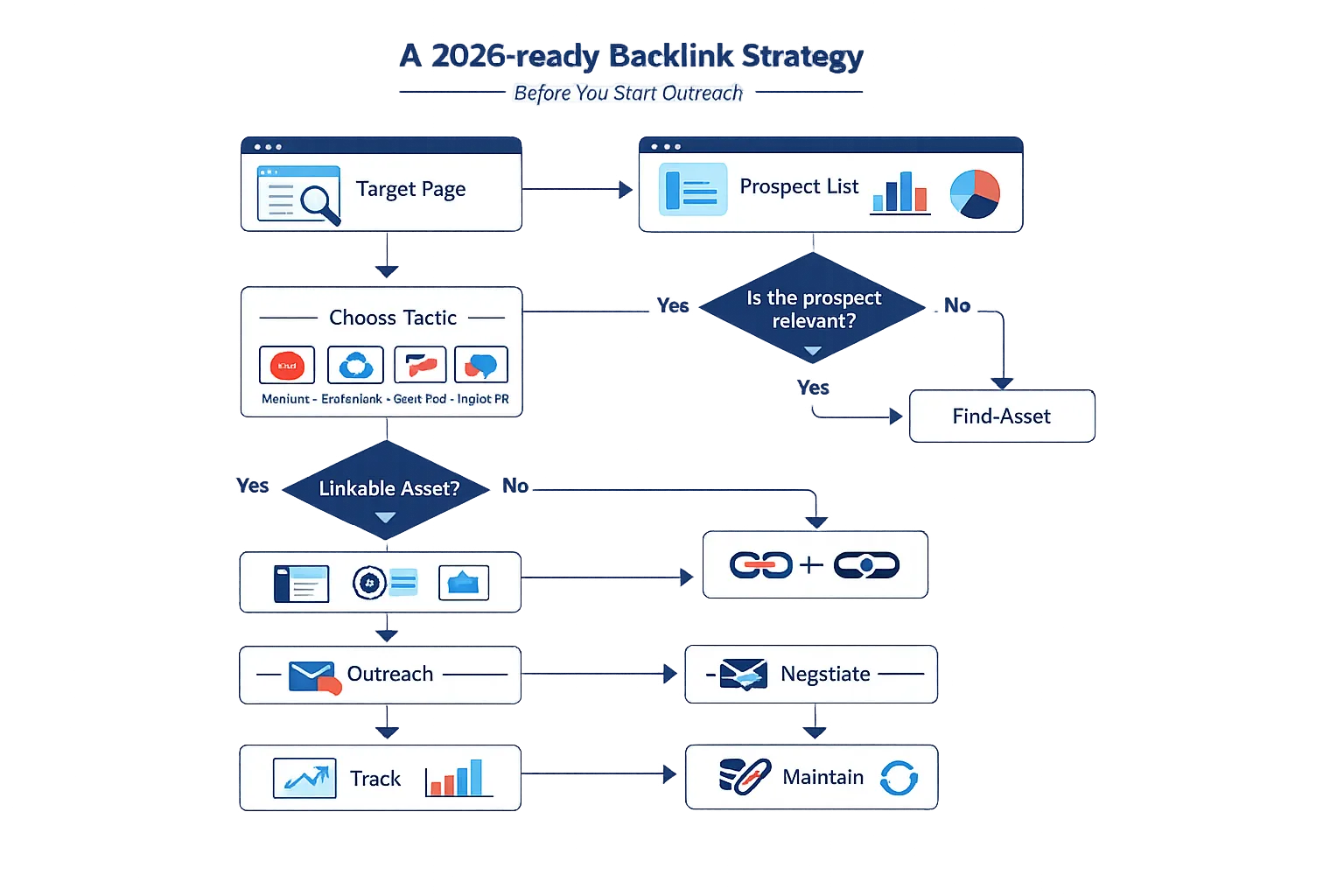
When it comes to keeping this organized at scale, Supawriter helps because content, research, internal linking, and publishing live in one place. That means when you earn a link, you can immediately update the page to better match intent and improve conversions.
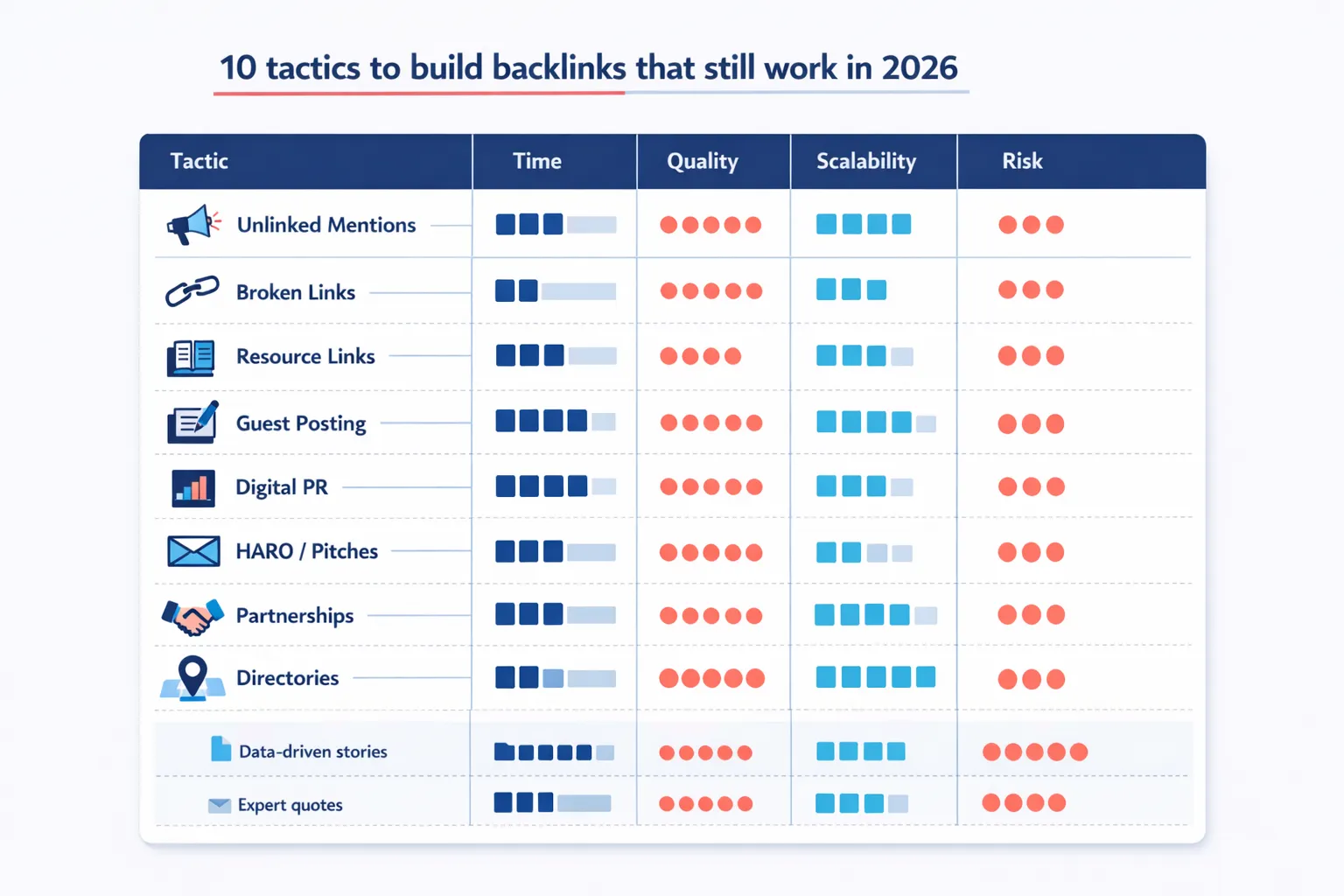
10 tactics to build backlinks that still work in 2026
Turn unlinked brand mentions into links
If your brand (or product) is already being mentioned, this is one of the cleanest quick wins for backlinks.
How to do it:
- Find pages that mention your brand but do not link.
- Confirm the mention is actually about you.
- Ask for the link to be added to the most relevant page (often your homepage is fine here, but the best page for users is usually better).
Why it works: you are not asking them to endorse you from scratch. You are just making the mention more useful.
Build links with broken link building
Broken link building still works because the pitch is helpful: you are pointing out a dead link and offering a replacement.
Steps:
- Find a relevant page in your niche with outbound links.
- Check for broken outbound links.
- If you have a legitimately good replacement resource, reach out.
Best for: content-led companies and SaaS with strong educational assets.
Publish linkable assets that attract natural links
Most backlink tactics fail because the page being promoted is not worth linking to.
A linkable asset is something people cite:
- Original data (mini-study, benchmarks, survey)
- Free tool or calculator
- Definitive glossary
- “Best X” curated lists that get updated
- Visual frameworks and templates
If you want a sustainable pipeline, treat linkable assets as part of your broader publishing engine. This is where Supawriter helps: you can plan the asset in your calendar, generate a long-form draft that matches your voice, and keep it updated so it continues earning links.
Guest posting with a value-first angle
Guest posting is not dead. Low-effort guest posting is.
What works in 2026:
- Pitch topics that match their audience’s intent
- Include a unique example, dataset, or framework
- Link only where it is genuinely helpful (usually one contextual link)
Avoid sending “I want to write for your blog” emails without specifics.
Resource page and “recommended tools” outreach
Many industries have pages like:
- “Resources for X”
- “Recommended tools”
- “Partners”
To earn these links, you need a page that makes you easy to recommend:
- Clear positioning (who it is for)
- Proof (logos, testimonials, screenshots)
- A short summary they can copy
Digital PR with data, quotes, and mini-studies
Digital PR has a high ceiling, but it needs a real story.
A simple pattern:
- Pick a trend your audience cares about.
- Produce a small dataset (even 50 to 200 data points can work if it is clean).
- Package it with charts and 3 to 5 takeaways.
- Pitch journalists, bloggers, and newsletter writers.
This is similar to what many link building guides recommend for earning links rather than chasing placements.
Partner and integration backlinks (SaaS-friendly)
If you are a SaaS company, partnerships are an underrated link source:
- Integration directories
- Partner pages
- Agency partner listings
- Co-marketing pages (webinars, templates, joint case studies)
These backlinks tend to be relevant, stable, and natural because they reflect real business relationships.
Testimonials and case study swaps (done ethically)
Writing testimonials for tools you truly use can earn links from their testimonial pages.
Rules:
- Only review products you have actually used
- Make it specific (results, use case)
- Do not demand anchor text
This shows up in many mainstream backlink lists because it is simple and ethical when it is genuine.
Local citations and niche directories (for trust, not magic)
Citations and directories are not a growth hack, but they can help establish legitimacy.
Good fits:
- Local business citations (if you serve local markets)
- Niche directories with editorial review
- Industry association listings
Avoid mass-submission “free backlinks” sites. You will get noise, not outcomes.
Reclaim lost backlinks and refresh old content
Link building is also link maintenance.
Every quarter:
- Check for links that disappeared
- Fix 404s and redirect properly
- Update the content so it stays worth linking to
If you are scaling content at the same time, map your refreshes into your broader plan: How to build a content strategy step by step.
How to create backlinks step-by-step (repeatable 30-day plan)
Week 1: Prepare your assets and targets
Your goal is to remove friction so outreach is easy.
- Choose 1 target page and 2 supporting pages
- Improve the target page so it is the best result for its intent
- Add internal links from supporting pages to the target
- Create one linkable angle (data, template, checklist, tool)
If you are also trying to grow overall traffic, connect link building to your wider SEO system: How to grow organic traffic in 2026.
Week 2: Build your prospect list and angles
Build a list of 50 to 150 prospects depending on your market.
For each prospect, write one angle:
- You mentioned us, but did not link
- You link to a broken or outdated resource we can replace
- Your resource page should include this updated guide
- Your article could be improved with this new dataset
The more specific your angle, the fewer emails you need.
Weeks 3 to 4: Outreach, follow-up, and ship improvements
Outreach is a loop:
- Send 10 to 20 high-quality emails per day (not 200 generic ones)
- Follow up once or twice
- If you get objections, improve the asset
- Track wins, losses, and patterns
A practical rule: every 20 to 30 sends, pause and ask, “Is our page genuinely cite-worthy?” If not, fix the page before sending more.
Backlink outreach templates that do not feel spammy
Unlinked mention template
Subject: Quick fix on your {page title}
Hi {Name},
I noticed you mentioned {Brand} in your article on {Topic}. Thanks for including us.
Would you be open to turning the mention into a link to {best URL} so readers can find the resource quickly?
Either way, appreciate the write-up.
Thanks,
{Your name}
Personalization tip: reference the exact sentence where you were mentioned.
Broken link replacement template
Subject: Broken link on your {topic} page
Hi {Name},
I was using your {page title} resource and noticed the link to {dead resource} appears to be broken.
If you are updating the page, this guide covers the same topic with updated examples: {your URL}.
Hope that helps and thanks for keeping the resource list current.
Best,
{Your name}
Resource page / tools list template
Subject: Suggestion for your {resources/tools} list
Hi {Name},
I’m putting together a few resources for {audience} and came across your {page title}. It is a solid list.
If you are updating it, {your brand} may be a useful addition for readers who need {specific outcome}. Here is the best page to review: {your URL}.
If it is not a fit, no worries. Thanks for publishing the list.
Regards,
{Your name}
What to avoid: risky backlink tactics and common mistakes
Buying backlinks and link schemes
If you are tempted to buy backlinks, separate the desire (speed) from the risk (unstable rankings).
Google’s spam policies explicitly call out buying or selling links that pass ranking signals as a link scheme.
If you do anything paid, keep it clearly on the right side of the line: sponsorships with proper disclosure and no expectation of manipulating rankings.
“Free backlink generators” and low-quality directories
“Build backlinks free” searches are popular because they promise speed.
In practice, automated backlinks usually mean:
- Spammy pages
- Irrelevant sites
- Links that get removed or deindexed
Even if you see a short-term bump, it is not a foundation you can build a business on.
Over-optimizing anchors and scaling too fast
The most common beginner mistake is forcing exact-match anchors everywhere.
Safer patterns:
- Brand name anchors
- URL anchors
- Natural anchors like “this guide” or “learn more”
Also, if you suddenly acquire a suspicious volume of low-quality links, you will spend months cleaning up instead of growing.
If you want link building to feel less chaotic, tie it to a repeatable publishing rhythm. Supawriter helps teams plan linkable assets, ship 2,500+ word articles in a consistent brand voice, and keep pages fresh so outreach turns into links that actually stick.
Backlinks are not a one-time project. They compound when your website publishes genuinely useful content, promotes it with a system, and maintains it over time. If you want that loop, explore how Supawriter can help you research, write, optimize, and publish content built to earn links in 2026.
Grow your traffic on autopilot now
Join thousands of users already using our platform.