Search Engines Other Than Google: 12 Best Picks for 2026
supawriter

If you are looking for search engines other than Google, the best choice depends on what you want from search. Some people want the closest thing to Google. Others want more privacy, fewer AI summaries, or better answers for research. In 2026, there is no single winner for every use case. The better move is to match the search engine to the job.
For SaaS founders, that same decision-first mindset matters in content too. You do not want more tools, you want the right workflow for the right stage. Supawriter helps teams do that with SEO research, long-form writing, internal linking, and publishing in one place, which is useful when you are building content around the exact search behavior your buyers use.
Quick answer: the best Google alternatives in 2026
If you want the short version, these are the best Google alternatives right now.
| Use case | Best pick | Privacy | Result quality | Speed | AI answers | Best for |
|---|---|---|---|---|---|---|
| Best overall alternative | Bing | Medium | High | Fast | Yes | General web search, shopping, maps, image search |
| Best private search engine | DuckDuckGo | High | Good | Fast | Limited | Privacy-first everyday search |
| Best for Android and daily use | Bing | Medium | High | Fast | Yes | Users who want a familiar experience |
| Best private engine with Google results | Startpage | High | High | Fast | No | Users who want privacy without giving up Google-style results |
| Best independent privacy option | Brave Search | High | Good | Fast | Optional | Users who want privacy and a non-Google index |
| Best no-AI preference | Startpage | High | High | Fast | No | Clean classic search |
| Best AI research engine | Perplexity | Medium | Strong for answers | Fast | Yes | Research, summaries, source-led exploration |
| Best for math and data | Wolfram Alpha | Medium | Specialized | Fast | Answer-based | Computation, formulas, structured facts |
| Best for Europe | Qwant | High | Good | Fast | Limited | EU users who want a privacy angle |
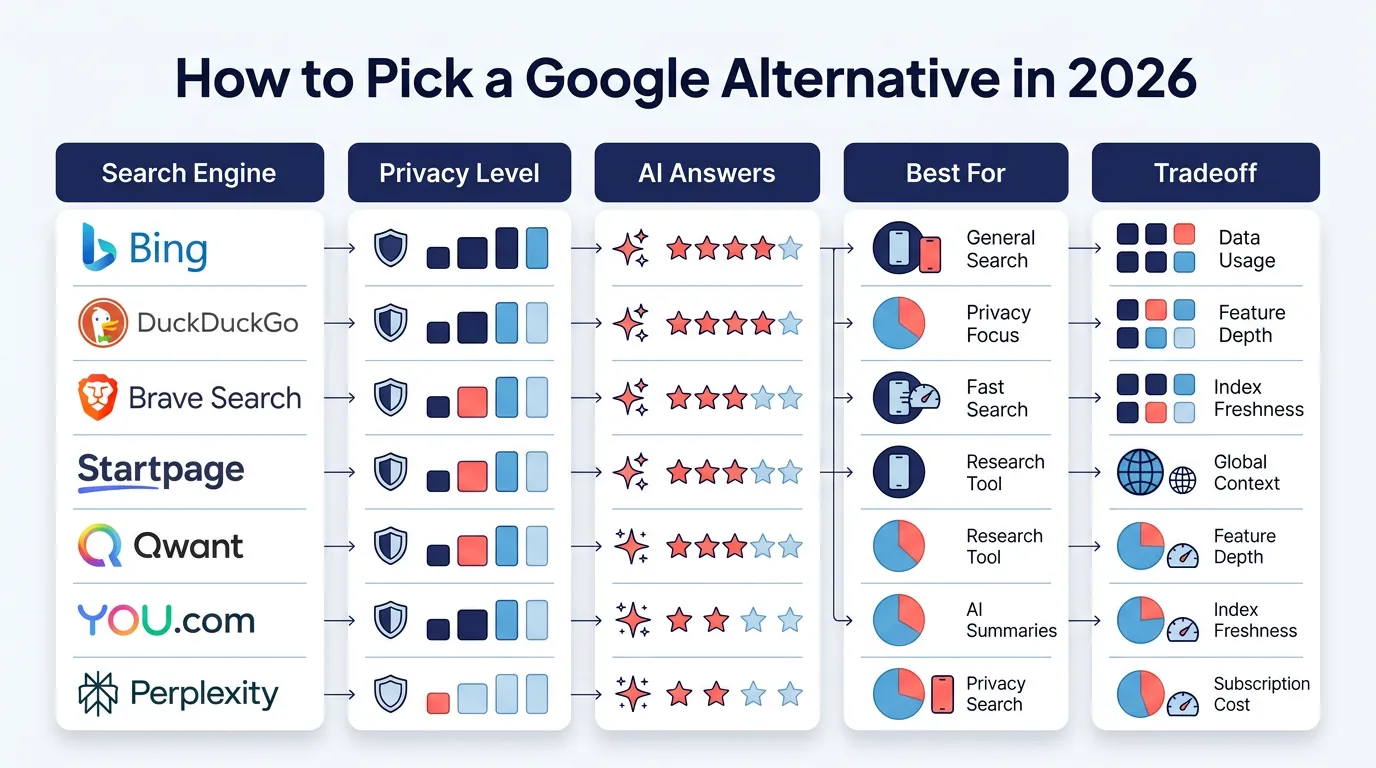
A few quick notes help here. Bing remains the closest mainstream replacement for Google because it has broad web coverage, strong image and video search, and integrated AI results in many markets. DuckDuckGo is still the easiest privacy-first switch for most people because it does not store personal search history and blocks many trackers in its browser tools. Brave Search stands out because it runs its own index for much of the web, which gives it more independence than privacy tools that rely mainly on bigger providers.
The rest of this guide looks at 12 options, but these three are the fastest answers for most readers:
- Best overall: Bing
- Best private search engine: DuckDuckGo
- Best for Android and everyday use: Bing
How we chose these search engines
To make this list useful, we did not just collect famous names. We looked at how each search engine fits a real use case.
Ranking factors we evaluated
We focused on six factors:
- Search result quality
- Speed on desktop and mobile
- Privacy and tracking behavior
- AI answers and whether you can avoid them
- Regional relevance
- Daily usability
That matters because market share alone does not tell you whether a search engine is good for your workflow. Google still dominates global search, but Bing remains the clear number two in many market-share datasets, making it the most realistic broad replacement for users who want familiar results and mainstream coverage.
Privacy and tracking considerations
Privacy means different things across search engines. Some engines avoid storing your search history. Some remove personal identifiers. Some use their own index, while others proxy results from larger engines.
That distinction matters. DuckDuckGo focuses on reducing tracking and personal profiling. Startpage is built around private access to Google results. Brave Search pushes further on index independence, which appeals to users who do not want both Google tracking and Google dependency. Qwant and Swisscows also position privacy as a core part of the product, though their result depth can vary more by query and region.
Index quality, features, and device compatibility
A search engine is only as useful as its index and interface. For everyday search, you want strong coverage for news, products, support docs, local intent, and long-tail questions. You also want a mobile experience that feels normal.
That is why Bing, DuckDuckGo, Brave Search, and Startpage sit near the top of this list. They cover general search well enough for daily use. Then there are answer engines like Perplexity and Wolfram Alpha, which work better for research tasks than for classic blue-link search.
This selection method is also similar to how SaaS teams should think about content systems. Supawriter helps teams connect research, SERP analysis, and publishing, instead of treating content like a pile of disconnected drafts. That is useful when your audience moves between Google, Bing, AI search, and privacy-first engines.
If you want a stronger framework for that side of the work, this guide on search intent is a good next read.
Best search engines other than Google
These are the core alternatives most readers should test first.
Bing
Bing is the best mainstream alternative to Google for most users. It is owned by Microsoft and has broad web coverage, strong image search, video search, shopping results, and a familiar interface. In 2026, it also remains one of the easiest ways to get AI-enhanced search without moving to a fully answer-first product.
Key features:
- Large web index
- Strong image and video search
- AI answers and chat features in many experiences
- Tight integration with Microsoft products
- Good desktop and mobile usability
Pros:
- Feels close to Google
- Good general search results
- Strong for shopping, image, and news queries
- Easy default choice on many browsers and devices
Cons:
- Less private than dedicated privacy engines
- AI elements may feel noisy if you want classic search
- Some users still find long-tail results weaker than Google
Best for:
- General web search
- Android users who want a simple replacement
- Teams that need broad result coverage
Pricing:
- Free
If you want one search engine to handle most day-to-day tasks, Bing is the safest pick.
DuckDuckGo
DuckDuckGo is still the best private search engine for most people because it keeps the experience simple. You do not need to change your habits much. You just get search with less tracking and fewer privacy concerns.
Key features:
- Privacy-focused search
- No personal search profile tied to your queries
- Clean interface
- Browser and tracker-blocking tools
- Bang shortcuts for direct site search
Pros:
- Easy switch from Google
- Strong privacy positioning
- Fast and clean results page
- Good for everyday searches
Cons:
- Result quality can feel mixed on niche queries
- Local search can be less precise than Google
- AI is not the main strength here
Best for:
- Privacy-first browsing
- Users who want a default search engine with low friction
- People who like a classic search page
Pricing:
- Free
DuckDuckGo is often the best answer when someone asks for a Google replacement that does not require a whole new workflow.
Brave Search
Brave Search is one of the most interesting Google alternatives because it aims for more index independence. That means it is not only a privacy brand, it is also trying to build a distinct search layer rather than leaning fully on bigger engines.
Key features:
- Privacy-focused search
- Independent web index for much of search
- Optional AI answer layer in some experiences
- Clean design
- Good browser integration, especially with Brave Browser
Pros:
- Strong privacy angle
- More independence than many private alternatives
- Good speed and interface
- Better fit for users who want less Google dependence
Cons:
- Result depth can vary by query
- Local results may be weaker than Google or Bing
- Some users will still prefer a larger mainstream index
Best for:
- Privacy-minded users
- People who want an independent search engine
- Founders who care about platform concentration risk
Pricing:
- Free
For privacy plus independence, Brave Search is one of the strongest picks in this list.
Privacy-focused search engines and no-AI options
If your main goal is fewer trackers or a more classic results page, these options are worth trying.
Startpage
Startpage is the best choice for people who want private search without giving up Google-style results. Its core value is simple: you get results associated with Google's index while Startpage sits between you and the tracking layer.
Key features:
- Private search experience
- Google-style results
- Minimal interface
- Strong fit for users who do not want AI summaries by default
Pros:
- Great result quality
- Strong privacy positioning
- Clean, classic interface
- Excellent for no-AI preference
Cons:
- Less product depth beyond core search
- Not as feature-rich as Bing
- Still tied to another engine's ecosystem for result sourcing
Best for:
- Users who want privacy with familiar result quality
- People actively looking for search engines other than Google with no AI
- Clean everyday searching
Pricing:
- Free
If your question is, "What can replace Google search without turning every query into an AI summary," Startpage is near the top.
Qwant
Qwant is a Europe-based search engine with a privacy-first position. It appeals most to users who care about regional identity, simpler search, and less personalization.
Key features:
- Privacy-focused approach
- Strong brand presence in Europe
- Web, news, and social-style discovery features
- Simple interface
Pros:
- Good for users who want a European alternative
- Privacy messaging is clear
- Easy to use
Cons:
- Less consistent result quality outside core markets
- Smaller mindshare than top alternatives
- Not always the best option for niche queries
Best for:
- European users
- Privacy-conscious searchers
- Users who want a simple engine without heavy AI framing
Pricing:
- Free
Qwant is a reasonable choice if regional trust matters as much as search features.
Swisscows
Swisscows is a privacy-focused search engine that emphasizes family-friendly search and semantic technology. It is more niche than DuckDuckGo or Startpage, but some users like its simpler feel and sharper filtering.
Key features:
- Privacy-first positioning
- Family-friendly filtering
- Semantic search angle
- Clean interface
Pros:
- Strong privacy message
- Family-safe setup for some use cases
- Easy to understand interface
Cons:
- More limited index depth
- Can feel restrictive for some queries
- Less useful for broad research than larger engines
Best for:
- Privacy-conscious households
- Users who value filtering and simpler search
- Those who want an alternative outside the usual list
Pricing:
- Free
This is not the best all-purpose engine, but it fits a specific user profile well.
When it comes to building content around privacy-related search behavior, Supawriter can help your team spot long-tail intent, build topic clusters, and publish fast enough to capture demand shifts across multiple search platforms. For a broader planning system, see this guide on how to build a content strategy.
Specialized and AI search engines to try
Some search products work best when you need answers, synthesis, or computation rather than a classic list of links.
You.com
You.com blends classic web search with AI-assisted answers and productivity features. It is useful if you like a search engine that tries to combine browsing, summarization, and work tools in one interface.
Key features:
- AI-assisted search
- Answer-style interface
- Productivity and workflow tools
- Mix of search and assistant behavior
Pros:
- Flexible search style
- Useful for idea generation and quick summaries
- Strong fit for users who want more than blue links
Cons:
- Can feel busy for simple searches
- Less ideal if you want a classic engine feel
- Accuracy still depends on source quality and query type
Best for:
- Founders doing quick competitive scans
- Users who want AI plus search in one tab
- Workflow-heavy research
Pricing:
- Free tier, paid plans may apply depending on product tier
You.com is closer to a work surface than a standard search engine.
Perplexity
Perplexity is one of the strongest answer engines for research-style search. Instead of showing only ranked links, it tries to produce a direct answer with cited sources. That makes it useful for synthesis, early research, and query exploration, though you should still verify important claims. Perplexity positions itself as an answer engine rather than a classic search page, which is why it works well for exploratory tasks.
Key features:
- Source-cited AI answers
- Follow-up question flow
- Strong research workflow
- Fast summarization of web content
Pros:
- Excellent for research and discovery
- Faster than traditional search for broad questions
- Good source visibility compared with many AI tools
Cons:
- Not ideal for simple navigational searches
- Answer quality can vary on sensitive topics
- Still requires fact-checking for high-stakes use
Best for:
- Research
- Market scans
- Founder-level learning and synthesis
Pricing:
- Free tier, paid plans may apply
If you are comparing products, markets, or regulations, Perplexity can save time. It is less useful when you just want the homepage of a site.
Wolfram Alpha
Wolfram Alpha is different from almost every other item here. It is not a broad web search engine in the normal sense. It is a computational answer engine built for structured questions, math, science, finance, and data.
Key features:
- Computational answers
- Math and formula support
- Structured data retrieval
- Strong educational and technical use cases
Pros:
- Excellent for calculations and factual computation
- Very strong for STEM queries
- Better than Google for many formula-based questions
Cons:
- Not a general-purpose web search tool
- Limited value for news, shopping, or local intent
- Interface is more specialized
Best for:
- Technical teams
- Analysts
- Students and operators working with numbers
Pricing:
- Free basic use, paid features may apply
For any query where calculation matters more than crawling the open web, Wolfram Alpha is the better tool.
How to choose the right alternative search engine
Now the practical part. Here is how to choose based on what you actually need.
For privacy-first browsing
Choose DuckDuckGo if you want the easiest private switch.
Choose Startpage if you want privacy but still care a lot about Google-like results.
Choose Brave Search if you want privacy plus more index independence.
Choose Swisscows if you want privacy with family-friendly filtering.
If your audience cares about privacy, this is also a content opportunity. Articles that compare tracking, personalization, and result quality can rank across both classic and AI-assisted search. Supawriter helps teams build those pages faster with real-time SERP analysis and internal-link suggestions. This article on SEO content is useful if you are turning product knowledge into search content.
For local and general web search
Choose Bing if you want the most complete Google replacement for general use.
Choose Startpage if you want strong result quality with a cleaner page.
Choose Qwant if you prefer a European privacy-first option and your search needs are fairly standard.
For local intent, mainstream engines still tend to perform better than smaller privacy products because local data, map integration, and business listings require scale.
For Android, research, and niche queries
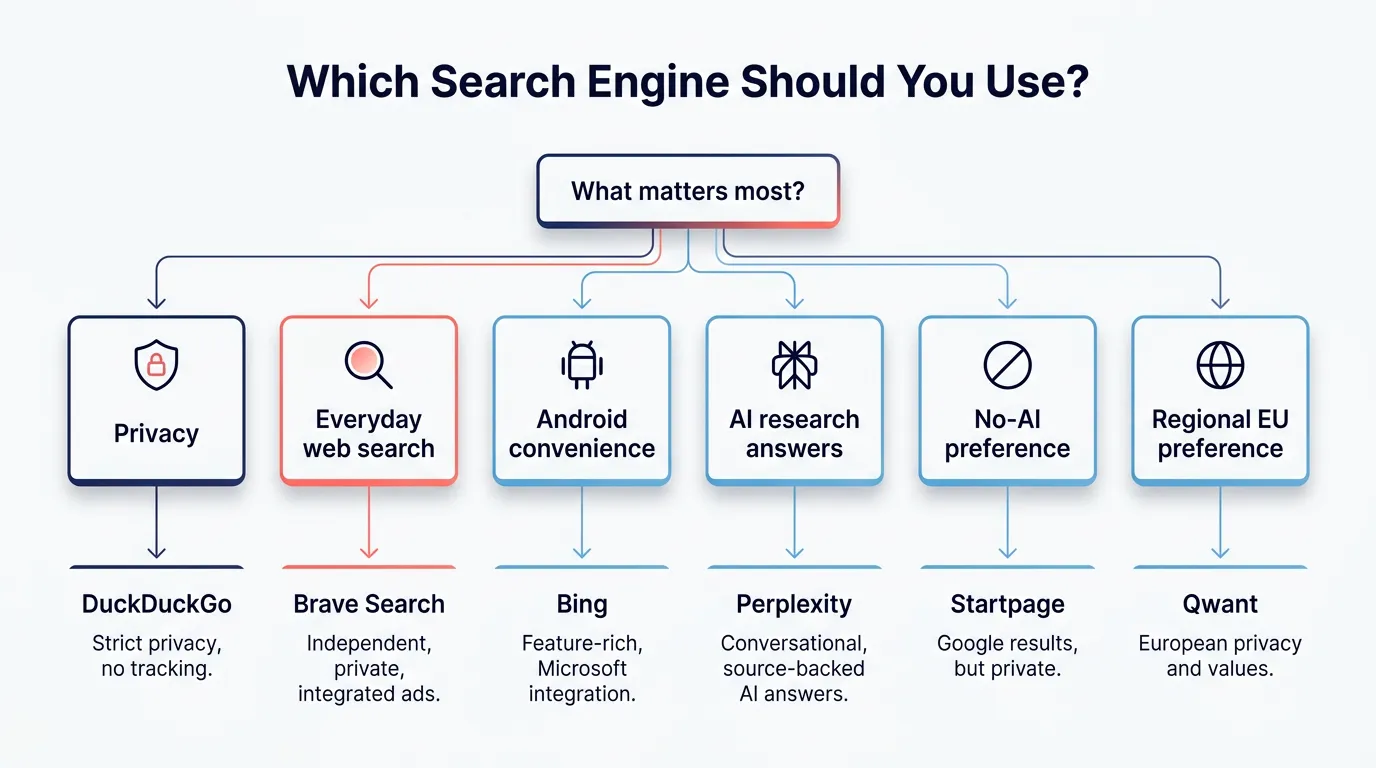
For Android and daily convenience, Bing is usually the easiest fit because it feels familiar and covers most use cases well.
For research and source-led answers, choose Perplexity.
For math, finance formulas, and structured queries, choose Wolfram Alpha.
For AI-assisted browsing with productivity angles, try You.com.
For no-AI preference, go with Startpage first, then DuckDuckGo or Qwant depending on your comfort with result variation.
A simple rule helps here:
- Use Bing for broad everyday search
- Use DuckDuckGo or Startpage for privacy
- Use Brave Search for privacy plus independence
- Use Perplexity for research
- Use Wolfram Alpha for computation
If you are scaling a content engine around these changing search habits, your editorial system needs to adapt too. This guide on automating SEO breaks down the workflow side, and on-page SEO checklists help keep execution consistent as channels shift.
FAQ about search engines other than Google
What is the best search engine other than Google?
For most users, Bing is the best search engine other than Google because it has the best mix of result quality, speed, and familiar features. If your top priority is privacy, DuckDuckGo is a better answer. If your priority is research, Perplexity is often more useful than either of them.
Which search engine is most private?
There is no single perfect answer, but DuckDuckGo, Startpage, and Brave Search are the strongest mainstream privacy picks. DuckDuckGo is easiest for daily use. Startpage is great if you want privacy with Google-style results. Brave Search is strong if you also care about index independence.
Are there search engines with no AI?
Yes. Startpage is one of the clearest options if you want a traditional results page without heavy AI summaries. DuckDuckGo, Qwant, and Swisscows can also feel more classic depending on the query and interface changes over time. If you are specifically searching for "search engines other than Google no AI," Startpage is the first one to test.
Is Brave Search better than DuckDuckGo?
It depends on what you value. Brave Search is better if you care about an independent index and want less reliance on bigger engines. DuckDuckGo is better if you want a smoother mainstream privacy experience with less learning curve.
Is Bing better than Google?
For most people, Bing is not better across the board, but it is good enough to replace Google for many daily tasks. Some users prefer Bing for image search, rewards, and Microsoft integration. Google still tends to be stronger for depth, local intent, and some long-tail queries.
What is the best Google alternative for Android?
Bing is the best Google alternative for Android if you want a familiar everyday search engine. DuckDuckGo is better if privacy matters more than pure result coverage. Perplexity is useful on Android too, but more for research than daily navigation.
The best search engines other than Google in 2026 are not all trying to do the same thing. Bing is the best broad replacement. DuckDuckGo is the easiest privacy-first switch. Brave Search is a strong independent option. Startpage is the best no-AI-style pick for many users. Perplexity and Wolfram Alpha are better viewed as specialized tools than direct Google replacements. If you are building content for audiences who search across all of these paths, Supawriter can help you research, write, optimize, and publish faster while keeping your brand voice and SEO process consistent.
Grow your traffic on autopilot now
Join thousands of users already using our platform.