Search Intent in SEO: What It Is and How to Optimize
supawriter
If you want more from SEO, you need more than keyword coverage. You need the right page for the right search at the right moment. That is what search intent is about. It is the reason a person types a query into Google, and it shapes which pages get seen, clicked, and trusted. For SaaS founders, that matters because a high-volume keyword can still fail if the page does not match what the searcher wants. Achieving that match is easier with Supawriter because it helps teams turn keyword research, SERP analysis, and content production into one workflow.
Search intent has always mattered, but in 2026 it is more visible in the results page itself. Google now blends AI answers, product modules, videos, People Also Ask boxes, and standard organic listings on the same query. That means you cannot optimize from a keyword list alone. You need to read the SERP, spot the dominant intent, and choose the format Google keeps rewarding. This article explains how search intent works, how to identify it, and how to build content that fits modern search behavior.
What is search intent?
Search intent is the goal behind a search query. When someone types a term into Google, they want something specific. They may want to learn, compare options, find a brand, or sign up for a tool. The words in the query matter, but the goal matters more.
In simple terms, search intent answers one question, what is the user trying to do right now?
That is why two keywords with similar wording can lead to very different results. A search for "crm software" often pulls comparison pages, product category pages, and list posts. A search for "how does crm software work" usually brings guides, definitions, and explainer content. Google reads the wording, compares it with past search behavior, and ranks the page type most likely to satisfy the query.
Search intent meaning
You will also see search intent called user intent, keyword intent, or query intent. All of those terms point to the same idea. A search is not just text. It is a signal of need.
For SaaS companies, that need usually sits somewhere in the funnel:
- Early stage, the person wants information
- Mid stage, the person wants options and proof
- Late stage, the person wants a product, price, or next step
If your content ignores that stage, the page can rank poorly or attract traffic that does not convert.
How Google interprets intent
Google has long said it aims to show helpful, reliable, people-first content, and its ranking systems try to surface results that best meet the searcher's need. Its guidance is built around satisfying users rather than creating pages only to manipulate rankings. Google Search, creating helpful, reliable, people-first content
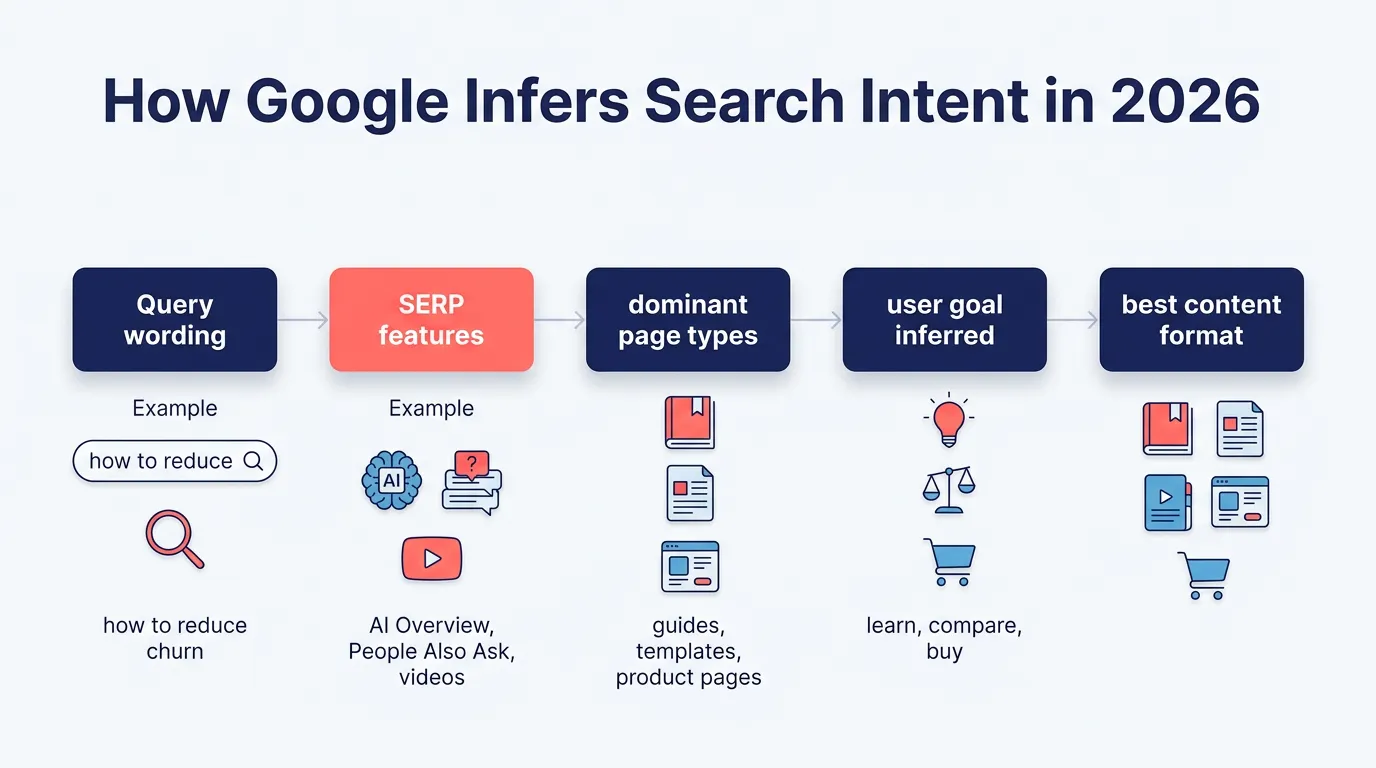
In practice, Google interprets intent through a mix of signals:
- Query wording
- Past user behavior on similar searches
- Freshness needs
- Location and device context
- Dominant content type already performing in results
- SERP features like AI Overviews, videos, shopping blocks, and People Also Ask
This is why intent is not something you declare on your own page. It is something you infer from the keyword and confirm from the live SERP.
Why intent is tied to user goals
Intent is tied to goals because search is task-driven. People use Google to complete something. They want an answer, a comparison, a definition, a download, a login page, or a purchase path.
That matters for content structure. A founder searching "best knowledge base software" has a different goal from a support lead searching "how to reduce support ticket volume." The first query needs comparison content. The second needs educational content with tactics, examples, and maybe a template.
When it comes to turning those goals into rank-ready articles, Supawriter gives teams a useful advantage. It combines real-time SERP analysis with writing and optimization, so your team can shape the page around what the searcher actually wants, not just around a target keyword.
Why search intent matters for SEO
Search intent matters because rankings are a relevance game. If your page format does not fit the query, strong on-page SEO alone will not save it.
Google can see when a result satisfies the search. It can also see when users bounce back to results and choose a different page. You do not need perfect behavioral data to understand the pattern. If searchers want a product comparison and land on a generic homepage, they will leave. If they want a quick definition and hit a 4,000-word sales page, they will leave.
How intent affects rankings
Search engines compare your page against what already works for that query. If the first page is full of list posts, your product page is less likely to rank. If the first page is full of docs, landing pages, or login URLs, a blog article may struggle.
That is why intent alignment is often the first ranking filter. Before domain authority, links, or content depth can help, your page has to be the right answer type.
Why mismatched content loses clicks
Even if a page appears in results, mismatch hurts click-through rate. The title may promise one thing while the searcher expects another. A person searching "best project management software for startups" expects a comparison angle. If your title says "Project Management Software Explained," fewer people will click because it feels early-stage.
This issue gets stronger in AI-heavy results. Pew Research Center found that users were less likely to click links when an AI summary appeared, and more likely to end the session without clicking any result. On pages with an AI summary, users clicked a traditional result in only 8% of visits, versus 15% on pages without one. Pew Research Center, How people are using Google search in the AI era
If clicks are harder to win, your page has to match intent faster.
How intent improves engagement
Intent alignment improves the full chain:
- Better rankings because the page fits the query
- Better CTR because the angle matches the need
- Better engagement because the reader finds the answer faster
- Better conversions because the CTA fits the stage
For SaaS teams, this is where SEO becomes efficient. You stop creating one-size-fits-all articles and start publishing pages with a clear job.
A practical example:
| Query | Likely intent | Better page format |
|---|---|---|
| how to build a sales pipeline | Informational | Step-by-step guide |
| best sales pipeline software | Commercial | Comparison page or list post |
| hubspot pricing | Navigational or transactional | Pricing page or brand page |
| sales crm free trial | Transactional | Product landing page |
If you want a broader framework for planning those pages, this guide on SEO content is a useful companion read.
The 4 main types of search intent
The classic model breaks search intent into four groups. It is still useful in 2026, as long as you remember that many keywords now blend two intents at once.
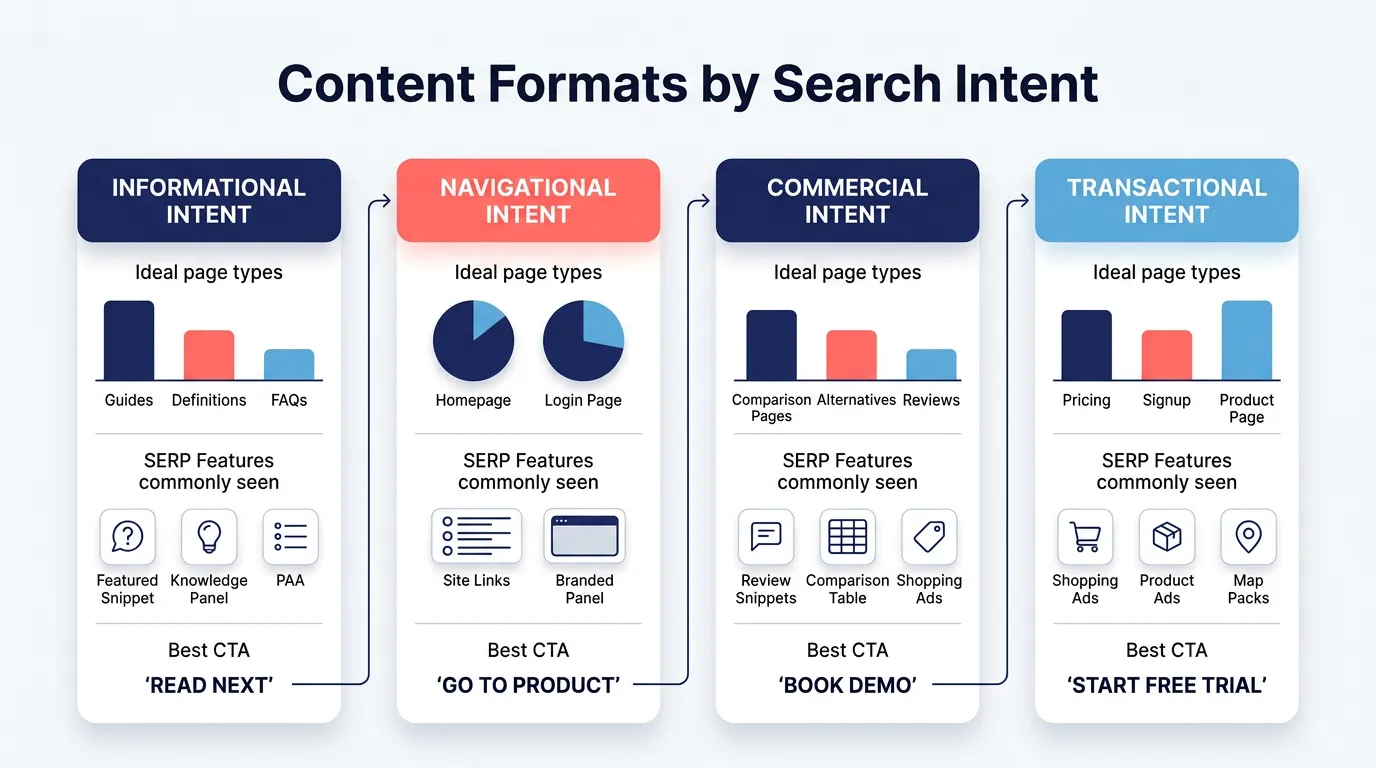
Informational search intent
Informational intent means the user wants to learn something. They may ask a question, define a term, solve a problem, or look for a process.
Examples:
- what is churn rate
- how to improve onboarding
- search intent meaning
- seo content strategy
Best content formats:
- Guides
- Tutorials
- Definitions
- Checklists
- FAQ pages
- Explainer videos
Best CTA style:
- Read related content
- Download a template
- Join a newsletter
- Try a free tool only if it feels relevant
For informational searches, your intro has to answer quickly. Then the rest of the page should expand naturally into the next questions the user is likely to ask.
Navigational search intent
Navigational intent means the user wants to reach a specific site, product, or page.
Examples:
- supawriter login
- ahrefs blog
- hubspot academy
- stripe pricing
Best content formats:
- Homepage
- Login page
- Docs page
- Pricing page
- Specific branded landing page
Best CTA style:
- Go to product
- Sign in
- View pricing
- Contact sales
You usually do not win navigational intent with a blog post unless the branded query includes an educational modifier.
Commercial search intent
Commercial intent means the user is evaluating options before a decision. This is where many SaaS buying journeys begin.
Examples:
- best email marketing software
- intercom alternatives
- semrush vs ahrefs
- top ai writing tools for seo
Best content formats:
- Comparison pages
- Alternatives pages
- Reviews
- Category roundups
- Use-case landing pages
Best CTA style:
- Book a demo
- Start free trial
- Compare plans
- See product walkthrough
Commercial intent often brings the strongest mix of traffic quality and conversion potential for Series A and B SaaS companies.
Transactional search intent
Transactional intent means the user wants to act now. They are close to signup, purchase, or download.
Examples:
- buy crm software
- project management software free trial
- payroll app pricing
- register webinar software
Best content formats:
- Product page
- Pricing page
- Signup page
- Category landing page
- App marketplace page
Best CTA style:
- Start free trial
- Request demo
- Buy now
- Create account
These pages should remove friction. They need clear proof, pricing context, feature highlights, and direct next steps.
How the type changes your page structure
The same topic can require a different structure depending on intent.
| Intent type | Main goal | Ideal structure | CTA fit |
|---|---|---|---|
| Informational | Learn | Fast answer, clear sections, examples, FAQs | Read more, subscribe |
| Navigational | Reach a destination | Minimal friction, strong brand cues | Visit page, sign in |
| Commercial | Compare options | Pros and cons, use cases, proof, alternatives | Book demo, compare plans |
| Transactional | Take action | Product details, pricing, trust signals, forms | Start trial, buy now |
How to identify search intent from a keyword
The easiest mistake in SEO is labeling intent from the keyword alone. You need the live SERP. Google has already tested what users respond to, and the results page is your best clue.
Analyze the current SERP
Start by searching the keyword in an incognito window or your SEO tool of choice. Then look for patterns in the top results.
Ask:
- Are the results mostly blog posts, product pages, or category pages?
- Are the titles educational, comparative, or transactional?
- Are well-known brands ranking with landing pages or with editorial content?
- Is the angle beginner-friendly or expert-level?
If eight out of ten results are list posts, the query is probably commercial. If most results are definitions and beginner guides, it is informational. If you see homepages, docs, or login pages, it is navigational.
Look for modifiers and query language
The keyword itself still gives useful clues. Certain words often map to certain intent types.
| Modifier pattern | Likely intent |
|---|---|
| what is, how to, guide, examples | Informational |
| login, pricing, docs, brand name | Navigational or transactional |
| best, top, vs, alternatives, review | Commercial |
| buy, trial, demo, sign up, coupon | Transactional |
Modifiers help, but they do not settle the question. "CRM software" could be commercial, transactional, or mixed depending on the live results.
Check content formats and ranking patterns
The format ranking on page one is often the clearest signal.
Look at:
- List posts
- Product pages
- Template pages
- Videos
- Tool pages
- Forum threads
- Documentation
Then check the page structure inside top-ranking results. Are they built around definitions, comparisons, tutorials, or pricing? The more consistent the pattern, the clearer the intent.
Watch the SERP features
In 2026, SERP features tell you a lot about intent:
- AI Overview often appears on broad informational or exploratory searches
- Shopping modules often appear on commercial and transactional searches
- Video carousels often signal process-based learning intent
- People Also Ask often expands informational searches into sub-questions
- Sitelinks and branded panels often point to navigational intent
Google's own updates around AI Mode show that search is becoming more multimodal and exploratory, with users asking longer and more complex questions. Google also said its Shopping Graph has over 45 billion product listings, with more than 2 billion listings refreshed every hour, which shows how heavily it supports comparison and buying journeys in results. Google, Meet AI Mode Google, Shopping Graph facts
For founders building repeatable workflows, this is where Supawriter helps again. It enables teams to move from keyword research to live SERP interpretation and then into a publishable draft without losing the thread of intent.
If you are building a wider workflow around this process, see this step-by-step guide to keyword competitive analysis and this practical framework for content strategy.
How to optimize content for search intent
Once you know the likely intent, optimization becomes much simpler. You are no longer trying to write the most complete page on a topic. You are trying to create the page that best fits what the searcher wants next.
Match the format to the query
This is the most important step.
If the SERP favors guides, publish a guide. If it favors alternatives pages, build an alternatives page. If it favors tool pages or templates, consider interactive content instead of a long article.
A mismatch here can waste months of work.
A simple rule:
- Informational query, teach
- Commercial query, compare
- Transactional query, convert
- Navigational query, remove friction
Align headings with the next question
Strong headings mirror how the user thinks. Each section should answer the next obvious question.
For example, if the keyword is "search intent," the likely sequence is:
- What is search intent?
- Why does it matter?
- What are the types?
- How do I identify it?
- How do I optimize for it?
- What changed in 2026?
That is why good intent-focused content often feels obvious. It reduces cognitive load because it follows the user's task.
Use CTAs that fit the stage of awareness
A bad CTA can break a good page.
If someone is reading an informational guide, "Book a demo now" is often too early. A better move is a softer next step, such as a template, checklist, newsletter, or related guide. On a commercial page, a demo CTA makes more sense. On a transactional page, a free trial or signup CTA is usually right.
Optimize the opening and first screen
Searchers decide quickly if your page fits.
Your opening should do three things in the first screen:
- Confirm the topic
- Deliver a direct answer or clear promise
- Show what comes next
This matters even more with AI Overviews in the mix. Ahrefs reported that when an AI Overview appears, the click-through rate on the top organic result drops by 34.5% for informational queries. Ahrefs, AI Overviews reduce clicks by 34.5%
If fewer users click through, the users who do arrive need to feel immediately confident they landed on the right page.
Improve content depth without losing focus
Depth helps when it supports intent. It hurts when it distracts.
For informational content, depth means examples, definitions, screenshots, and related sub-questions. For commercial content, depth means criteria, feature comparisons, implementation notes, and proof. For transactional content, depth means pricing clarity, onboarding details, security notes, and support expectations.
Do not pad. Expand only where the user still needs help.
Build internal links by intent stage
Internal links work better when they move readers to the right next step.
For example:
- Informational article to deeper educational guide
- Guide to commercial comparison page
- Comparison page to pricing or demo page
That is a better system than randomly linking related keywords. If you want examples, this article on how to scale content production and this guide to automating SEO both show how structured workflows compound over time.
Search intent in 2026: AI Overviews, mixed intent, and content strategy
The standard four-type framework still works, but it is no longer enough on its own. Search results now blend formats more often, and Google is more willing to satisfy part of the query directly on the results page.
How AI Overviews change click behavior
AI Overviews push simple answers higher up the page. That changes which informational queries still send strong traffic and which ones mostly generate impressions.
For founders, the takeaway is practical:
- Basic definition content still matters for topic coverage
- Deeper, experience-led content matters more for winning the click
- Original examples, templates, visuals, and a clear point of view help you stand out after the summary
This matches Google's people-first guidance. If your page adds nothing beyond what a quick answer box can summarize, it becomes easier for the SERP to absorb the value before the click. Google Search, creating helpful, reliable, people-first content Google, Meet AI Mode
Handling keywords with multiple intents
Many valuable SaaS keywords are mixed intent.
Take "customer onboarding software." Depending on the SERP, you may see:
- List posts comparing vendors
- Category pages from review sites
- Product landing pages
- Video explainers
- AI Overview summaries
That means one page may not do the whole job.
A better approach is to map one primary intent and one secondary intent.
Example:
- Primary intent, commercial
- Secondary intent, informational
Then build the page around the primary need while supporting the secondary one. A comparison page can still include a short explainer on what onboarding software is and who needs it. But the page should still lead with evaluation criteria, vendor fit, and next-step CTAs.
Building intent-focused content clusters
This is where strategy gets stronger.
Instead of creating isolated articles, build clusters around the full intent journey:
| Funnel stage | Intent focus | Example topic | Best page type |
|---|---|---|---|
| Awareness | Informational | what is product analytics | Educational guide |
| Consideration | Commercial | best product analytics tools | Comparison page |
| Decision | Transactional | product analytics pricing | Pricing or product page |
| Retention | Informational | how to improve product adoption | Advanced guide or template |
This model helps you capture more of the journey, not just the first click. It also creates cleaner internal linking and better CTA sequencing.
Supawriter enables teams to do this at scale because it combines writing, SERP research, optimization, internal linking, visuals, and publishing in one system. That matters when your team wants to build clusters instead of isolated posts.
What Google tends to favor now
While every query is different, modern SERPs often reward a few common traits:
- Fast clarity at the top of the page
- A format that matches dominant results
- Coverage of adjacent questions from People Also Ask and related searches
- Trust signals, examples, screenshots, or firsthand insight
- A clean next step aligned with the stage of intent
For SaaS founders, the business lesson is simple. Search intent is not a theory exercise. It is a prioritization tool. It tells you which page to create, how to structure it, which CTA to use, and where that page fits in the funnel.
If your team is already publishing but not seeing enough traction, intent mismatch is one of the first things to check. A keyword may be right while the page type is wrong. Fix that, and rankings, clicks, and conversions often improve together.
Search intent is also one of the easiest ways to make your SEO program more efficient. You waste less time producing pages that never had the right angle to begin with. You create better alignment between content, product, and revenue goals. And you build a site architecture that supports the full buying journey.
If you want to move faster on that process, explore Supawriter. It helps SaaS teams research live SERPs, match content to intent, generate useful visuals, build internal links, and publish SEO-ready content without losing brand voice.
Grow your traffic on autopilot now
Join thousands of users already using our platform.