Keyword Competitive Analysis: Step-by-Step Guide and Tools (2026)
supawriter

Keyword competitive analysis is how you stop guessing and start building an SEO plan around what already works in your market. Instead of brainstorming “good keywords”, you identify the exact keywords your competitors rank for (or buy in ads), then decide which ones you can realistically beat with better intent match, stronger content, and smarter page targeting.
If you want to take this from research to a publish-ready draft without juggling tools, Supawriter helps you move faster, with SEO optimization, internal linking suggestions, visuals, and scheduling in one workflow.
What keyword competitive analysis is (and what it is not)
Keyword competitive analysis vs keyword difficulty
Keyword difficulty (KD) is a tool-generated estimate of how hard it might be to rank for a keyword. Competitive analysis is broader, it’s the process of mapping your competitors’ keyword footprint to your site so you can find gaps, quick wins, and priorities.
In practice, you’ll use KD as one input, but you’ll validate it against real SERP factors like intent, content quality, and how entrenched the current top pages are.
Competitor keyword analysis vs keyword gap analysis
People use these interchangeably, but there’s a useful distinction:
- Competitor keyword analysis asks: “What keywords drive traffic to competitor X?”
- Keyword gap analysis asks: “Which keywords do competitors rank for that I don’t (or where I’m weaker)?”
Gap analysis tools explicitly label “missing”, “weak”, or “untapped” opportunities. For example, Semrush’s Keyword Gap compares up to five domains and surfaces “Missing” keywords where competitors rank but you have no ranking (Semrush Keyword Gap feature page).
When this analysis drives the biggest SEO gains
Keyword competitive analysis pays off most when:
- You have baseline SEO traction, but growth has slowed.
- Your site has content, but it’s not mapped cleanly to intent.
- Competitors are winning topic clusters you haven’t built yet.
- You need a fast path to topics with proven demand.
How to do keyword competitive analysis step by step
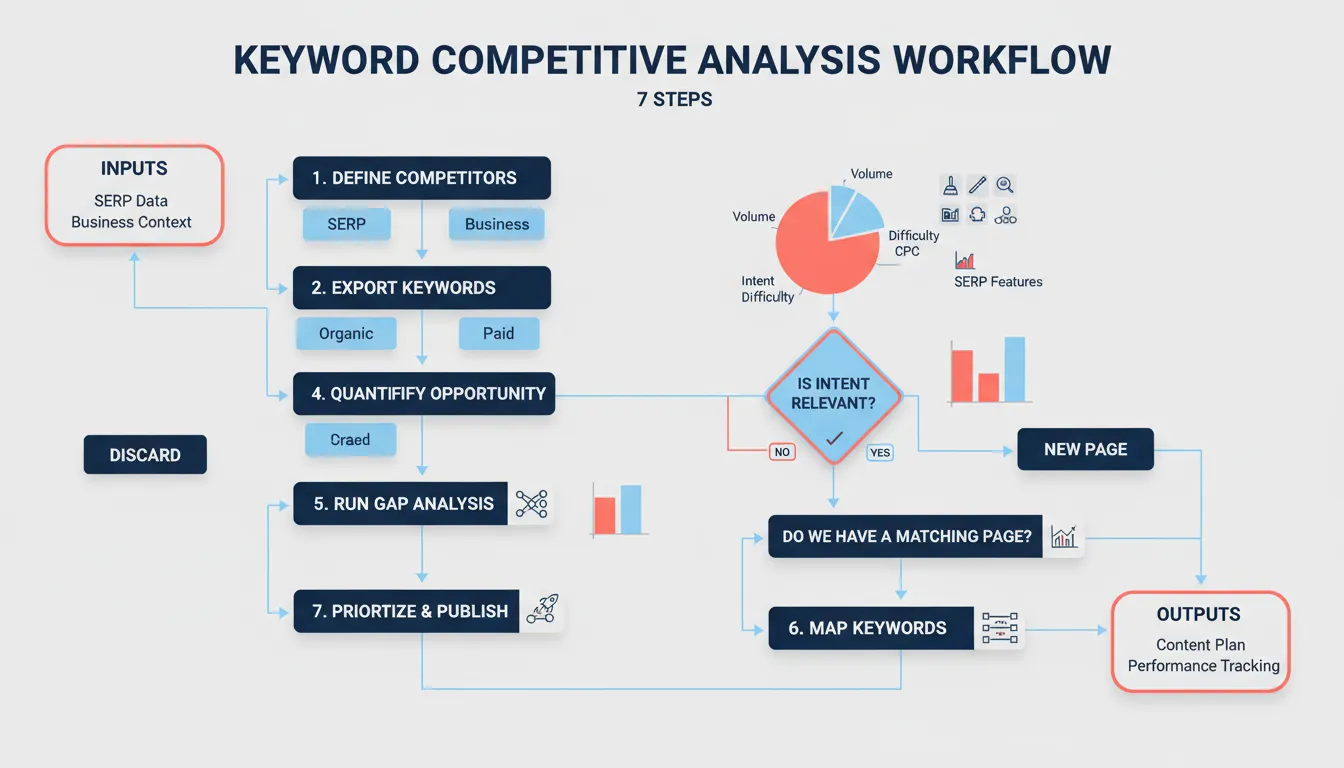
Step 1: Pick the right competitors from the SERP
Start with a short list of 5 to 10 “search competitors”, not just business competitors.
- Pick 5 to 10 high-intent keywords you care about (money pages and problem-aware terms).
- For each keyword, list the domains that consistently show up on page one.
- Separate them into:
- Direct SERP competitors: similar product/service and audience
- Content competitors: blogs and aggregators outranking everyone
- Feature owners: brands winning snippets, PAAs, templates, or tools
This prevents a common trap: benchmarking against a business competitor that doesn’t actually dominate the SERP.
Step 2: Export competitor keywords (organic and paid)
Pull both organic and PPC keywords when possible. Organic shows what they’ve won over time, paid can reveal what converts.
Organic keyword exports (common options):
- “Top keywords” / “Organic keywords” reports in SEO suites
- “Competing domains” or “Content gap” style reports
Paid keyword exports (common options):
- PPC keyword reports and ad history
SpyFu, for example, supports exporting competitor keyword lists from its SEO and PPC keyword areas, including options to filter before exporting (SpyFu Help Center).
Practical tip: export more than you think you need, then narrow later. It’s easier to filter 20,000 keywords down to 200 than it is to realize you missed a category and redo the work.
Step 3: Clean, cluster, and label intent before scoring
Before you prioritize, make your dataset usable:
- Remove noise:
- branded terms (yours and theirs)
- irrelevant industries (false matches)
- countries/locations you don’t serve
- Cluster by topic
Group keywords that should be satisfied by the same page. If multiple keywords share the same intent and SERP pattern, treat them as one “page opportunity”.
- Label intent
Use a simple label set:
- Informational (learn)
- Commercial (compare)
- Transactional (buy)
- Navigational (brand/page)
Many tools now include automated intent classification in keyword overview views, which speeds up triage (Semrush Keyword Overview knowledge base).
How to measure keyword competition in practice
Use difficulty scores, but validate with SERP reality
KD scores are a helpful first filter, especially when you’re scanning thousands of competitor keywords. But they don’t capture intent nuance or the actual strength of the current pages.
Use KD to sort, then do SERP checks on your finalists:
- Are results mostly blogs, product pages, or tools?
- Are the top pages fresh and frequently updated?
- Is Google rewarding brands, or is it rewarding usefulness and specificity?
Evaluate intent match, content depth, and SERP features
Competition isn’t only about links. It’s also about whether you can match the format Google is already rewarding.
Look for:
- Format match: list, template, guide, comparison, tool, category page
- Depth match: does page one require a 500-word answer or a 3,000-word playbook?
- SERP features: snippets, “People also ask”, videos, local packs
If the SERP is dominated by how-to guides and you publish a thin landing page, you’ll struggle even if KD looks moderate.
Check authority signals and link requirements
A fast way to sanity-check competition:
- Compare the typical brand strength of ranking domains.
- Look at how many credible sites reference the top pages.
- Identify whether the SERP is “locked” by a few dominant properties.
Also remember the payoff curve: Backlinko’s analysis of about 4 million Google results found the #1 organic result gets about 27.6% of clicks (Backlinko CTR study). That’s why it’s worth prioritizing battles you can actually win.
Best tools for competitor keyword analysis (2026)
You’ll find three broad tool categories in the SERP:
- All-in-one SEO suites (keyword + links + audits)
- Competitive intel / PPC spy tools
- Free tools for baselines and ideation
Below is a practical shortlist that maps to what you’ll see on page one for this topic.
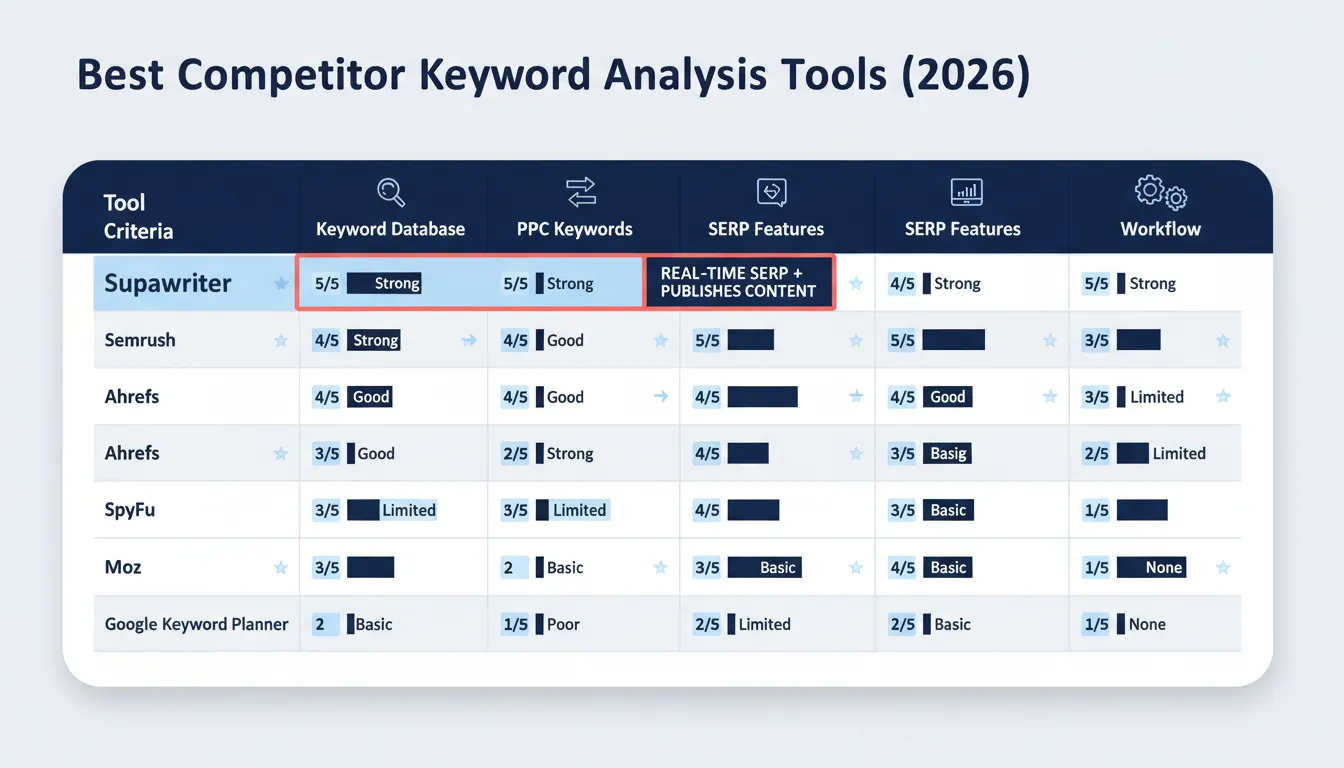
| Tool | What it’s best at | Strengths | Tradeoffs |
|---|---|---|---|
| Supawriter | Turning competitor keyword insights into publish-ready SEO content | Real-time SERP analysis, SEO optimization, internal linking support, visuals, scheduling, CMS + publishing | Not a standalone “keyword database only” product; it’s built for execution and velocity |
| Semrush | Keyword metrics + gap analysis workflows | Keyword intent, Keyword Gap, SERP analysis, large keyword sets | Can be complex if you only need one narrow workflow |
| Ahrefs | Competitive research plus strong link intelligence | Site Explorer for competitor pages/keywords, backlink context | Paid search data can be volatile compared to Google Ads-only sources |
| SpyFu | PPC competitor keywords + historical ad intel | Export PPC keywords and see ad-focused competitive patterns | More specialized vs broader site auditing suites |
| Moz | Accessible SEO metrics and keyword research | Straightforward UI, helpful keyword research concepts | Some advanced competitive datasets may be deeper in other platforms |
| Google Keyword Planner | Baseline keyword discovery for ads | First-party ads tool for keyword ideas and planning | Not built for competitor keyword “who ranks for what” analysis |
Supawriter
If your bottleneck is turning keyword research into pages that ship, Supawriter is built for that handoff.
Supawriter is an AI-powered content engine that helps you go from a keyword opportunity to a complete long-form draft (2,500+ words when needed), optimized for SEO and ready to publish.
Key features for competitive keyword work:
- Real-time SERP analysis to align with what’s currently ranking
- Automatic keyword targeting and meta tag support
- Internal linking assistance so new pages fit your site architecture
- Contextual visuals and AI image creation
- Smart scheduling and an AI-generated content calendar
- CMS and publishing workflows to deploy to any website
Pros:
- Best choice if your bottleneck is execution, not ideas
- Built for teams that need content velocity without losing brand voice
Cons:
- If you only want a raw keyword dump and nothing else, you may still pair it with a database tool
Best for: SaaS founders and growth teams who want to close keyword gaps fast by shipping high-quality pages consistently.
Pricing: check the product site for current plans.
Semrush
Semrush is a comprehensive SEO suite that’s widely used for keyword research, keyword difficulty, SERP analysis, and competitor gap workflows.
Key features:
- Keyword intent and SERP feature insights inside keyword overviews
- Keyword Gap that compares up to five domains and lets you filter “Missing” and “Weak” terms for quick wins (Semrush Keyword Gap)
Pros:
- Strong for structured gap analysis and exports
- Helpful for building prioritized keyword lists at scale
Cons:
- It’s easy to over-collect keywords without a clear plan to map them to pages
Best for: teams that want robust research, reporting, and competitive comparisons.
Pricing: varies by plan; confirm on Semrush.
Ahrefs
Ahrefs is a competitive research platform known for strong backlink data plus tools to see competitor pages and what they rank for.
Key features:
- Site-level views of organic performance and pages
- Backlink context to estimate how hard it will be to outrank top results
Pros:
- Excellent for link-informed competition analysis
Cons:
- Paid search visibility can vary because ads change frequently; Ahrefs notes PPC reporting reflects what it saw in SERPs during its updates, and ads can disappear due to auction volatility (Ahrefs PPC help article)
Best for: SEO teams who want competitive keyword research tightly connected to link strategy.
Pricing: varies; confirm on Ahrefs.
SpyFu
SpyFu is a competitor intelligence tool with a strong emphasis on PPC keyword and ad history, plus SEO keyword exports.
Key features:
- Find competitor PPC keywords and export them
- PPC competitor research that surfaces keywords a domain has bought and how they focus over time (SpyFu PPC keywords page)
Pros:
- Great for “what are competitors paying for?” insights
Cons:
- You may still want a separate workflow for turning insights into content production
Best for: marketers running SEO + Google Ads who want competitor PPC visibility.
Pricing: varies; confirm on SpyFu.
Moz
Moz is an SEO platform with keyword research and competitive analysis concepts that are easy to apply.
Key features:
- Keyword research workflows and SEO education
- Useful authority metrics for quick competitive comparisons
Pros:
- Approachable for small teams
Cons:
- Some teams pair it with other tools for deeper competitive datasets
Best for: teams that want a simpler stack and clear SEO guidance.
Pricing: varies; confirm on Moz.
Google Keyword Planner
Google Keyword Planner is Google Ads’ built-in tool for discovering keywords and planning campaigns.
Key features:
- Keyword discovery and planning for advertising
Pros:
- Free to access with a Google Ads account
- Useful baseline for keyword ideas and commercial intent clues
Cons:
- Not designed for competitor keyword gap analysis (who ranks for what)
Best for: baseline keyword ideation and PPC planning.
Pricing: free tool; ad spend optional.
Keyword competitive analysis example you can copy
Build a 1-page keyword gap sheet
Here’s a lightweight template you can paste into Sheets. The goal is to turn a messy export into a prioritized list of page opportunities.
| Cluster (page topic) | Example keywords in cluster | Intent | Competitor ranking URL | Your current URL | Gap type (Missing/Weak) | Priority (H/M/L) | Notes |
|---|---|---|---|---|---|---|---|
| “Customer onboarding checklist” | customer onboarding checklist, saas onboarding checklist | Informational | competitor.com/blog/onboarding-checklist | yoursite.com/blog/onboarding | Weak | H | Needs updated examples + template |
| “CRM for startups” | best crm for startups, crm startup | Commercial | competitor.com/best-crm-startups | none | Missing | H | New comparison page |
| “Free OKR template” | okr template free, okr spreadsheet | Transactional | competitor.com/templates/okr | yoursite.com/resources/okr | Weak | M | Improve UX, add downloadable |
If you need a refresher on what “SEO content” should look like once you pick the cluster, use this guide: what SEO content is and how to create it.
Turn gaps into a publish plan (new pages vs refreshes)
Once you’ve got 20 to 50 clusters, decide what to build first:
- Refresh when you already have a page that matches intent, but it’s underperforming.
- Create new when you have no page that matches the SERP’s intent.
A simple prioritization rule that works well:
- Missing + high-intent commercial keywords
- Weak keywords where you rank positions 8 to 20 (often faster wins)
- Informational clusters that support product-led or demo-led journeys
Then translate that list into a calendar. This pairs well with a documented workflow like: how to build a content strategy step by step and how to build a content calendar in 2026.
Track results and refresh quarterly
Competitive landscapes change, so make this a quarterly habit:
- Re-run your gap report
- Audit pages you shipped last quarter
- Expand winners into clusters (supporting posts + internal links)
If you’re also comparing authority signals, this primer helps teams stay consistent: Ahrefs DR vs Moz DA and how to use them.
The fastest way to make keyword competitive analysis pay you back is to shrink the time between “found opportunity” and “published page”. That’s where Supawriter fits, it helps you research the SERP, create on-brand long-form content, add SEO elements like internal links and metadata, and keep a predictable publishing cadence so you can compound results over months, not just weeks.
Grow your traffic on autopilot now
Join thousands of users already using our platform.