Content Strategy for Lead Generation That Drives Results
supawriter
If you want content to generate leads, you need more than a publishing schedule. You need a system that connects search intent, audience pain points, offers, and conversion paths. That is what a strong content strategy for lead generation does. Instead of chasing pageviews, you build content that attracts the right people, gives them a next step, and moves them closer to a sales conversation.
Most high-ranking guides on this topic follow the same pattern: define lead generation clearly, map content to the funnel, recommend specific content types, and show how to measure results. This article follows that structure with a practical focus for modern B2B teams. If you are building a repeatable engine, Supawriter helps turn strategy into execution with SEO planning, long-form drafting, internal linking, publishing workflows, and real-time research support.
What content strategy for lead generation really means
How content turns traffic into qualified leads
A content strategy for lead generation is the plan you use to attract potential buyers and convert their interest into identifiable demand. In practice, that means each piece of content should do one of three jobs: bring in qualified traffic, capture contact information, or help move existing leads toward a decision.
That sounds simple, but many teams stop at publishing educational blog posts. Traffic alone is not the goal. The goal is turning attention into action. A useful article, webinar, template, or case study should connect naturally to a call to action, whether that is an email signup, demo request, downloadable asset, or product trial.
This is also why SEO and lead generation work best together. Search brings in people who are already looking for answers. When your content meets that need and offers a relevant next step, the jump from visit to lead becomes much more natural. Forrester said that more than half of large B2B purchases are expected to happen through digital self-serve channels in 2025, which reinforces the need for content and conversion experiences that do more of the selling before a sales call begins (Forrester).
Why intent matters more than volume
The best lead generation content does not always target the biggest keyword. It targets the right problem at the right moment. Someone searching for a broad educational term may only want definitions. Someone searching for a comparison, template, checklist, or solution-specific query is often much closer to converting.
That is why intent should shape your entire content plan. Informational content builds awareness. Commercial and solution-aware content creates pipeline. A balanced strategy includes both, but the deeper-funnel content usually has stronger lead potential.
For example, a post on a broad topic like content marketing may drive more traffic than a page on lead generation content templates. However, the second topic may produce more qualified leads because the visitor is already looking for something usable.
The core elements of a lead-generating strategy
To make content generate leads consistently, you need a few pieces working together:
| Element | What it does | Why it matters |
|---|---|---|
| Audience definition | Clarifies who you want to attract | Keeps content focused on qualified buyers |
| Keyword and intent research | Reveals what prospects are searching for | Helps you prioritize topics with business value |
| Funnel mapping | Matches content to awareness, consideration, and decision | Prevents over-investing in top-of-funnel only |
| Offers and CTAs | Gives readers a next step | Converts traffic into leads |
| Landing pages and forms | Captures information with less friction | Improves conversion rate |
| Measurement | Connects content to pipeline | Shows what to scale or cut |
If you need the broader planning framework first, this guide on how to build a content strategy pairs well with a lead generation program because it helps you align goals, audience, and workflow.
How to build a content strategy for lead generation
Set lead generation goals and define conversion points
Start with outcomes, not topics. Ask what kind of leads you need, how many, and what counts as a meaningful conversion. That could be demo requests, newsletter subscribers, webinar registrations, free trial signups, or downloads of a high-intent resource.
Clear goals make prioritization easier. If your sales team needs more pipeline from mid-market buyers, your content should support that specific audience and offer. If your business has a long sales cycle, you may need multiple conversion points, from light-touch email capture to deeper product-focused requests.
It also helps to define conversion points by funnel stage:
| Funnel stage | Visitor intent | Best conversion point |
|---|---|---|
| Awareness | Learning, researching, defining a problem | Newsletter signup, checklist, template |
| Consideration | Comparing approaches, evaluating options | Webinar signup, guide download, case study |
| Decision | Validating a solution, reducing risk | Demo request, free trial, contact sales |
WordStream emphasizes goal setting, audience insight, and intent-driven keyword choices as core parts of lead-generating content strategy, which lines up closely with what performs in this SERP (WordStream).
Map audience pain points to the buying journey
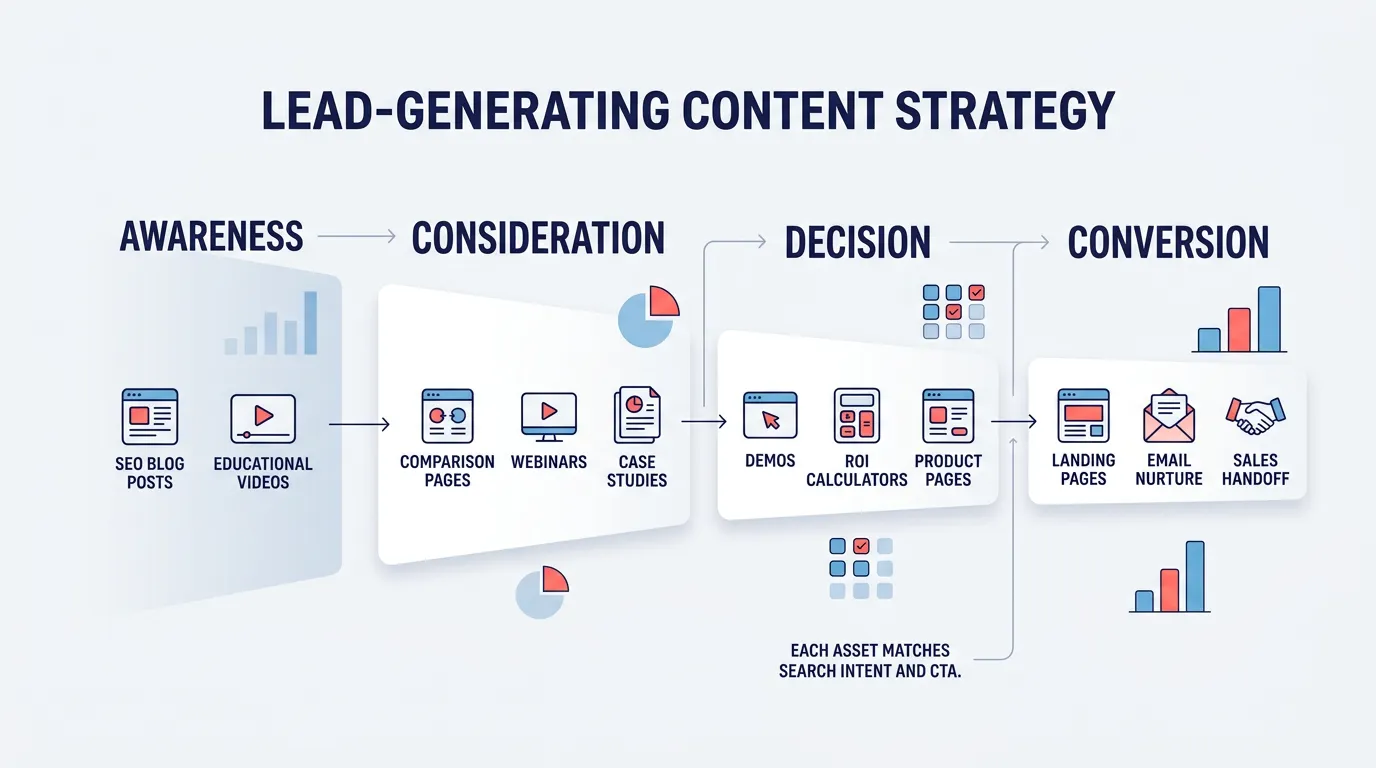
Once your goals are clear, map your audience's questions across the journey. Early-stage buyers ask broad questions. Mid-stage buyers want frameworks and proof. Late-stage buyers want specifics, validation, and confidence.
For a B2B SaaS company, that map might look like this:
- Awareness: what is the problem, why does it matter, how are peers solving it
- Consideration: which approaches work, which tools or workflows are best, what should a strategy include
- Decision: what platform should we choose, what ROI can we expect, how hard is implementation
This is where keyword research becomes more strategic. You are not just collecting phrases. You are building a content roadmap around buying-stage questions. That usually means combining broad educational topics with comparison, template, use-case, and bottom-funnel pages.
Create a content roadmap with offers and CTAs
Now turn that journey map into a plan. Each content topic should have four things attached to it: target keyword, target persona, funnel stage, and primary CTA.
A simple roadmap might include:
- SEO blog posts that target high-intent informational searches
- Gated templates or guides connected to those posts
- Case studies that support solution evaluation
- Comparison or use-case pages for bottom-funnel visitors
- Email nurture sequences that continue the conversation after conversion
The missing piece for many teams is CTA fit. A visitor reading a beginner article is unlikely to request a demo immediately. A checklist, template, or newsletter offer makes more sense. On the other hand, someone reading a product comparison page may be ready for a trial or sales conversation.
Supawriter can help teams plan topics, build optimized briefs, generate long-form content, suggest internal links, and maintain publishing momentum from one place. If your team struggles with consistency, a structured content calendar can keep roadmap execution realistic.
The best content formats for lead generation
Top-of-funnel content that attracts the right audience
Top-of-funnel content brings qualified visitors into your ecosystem. The strongest formats here are SEO blog posts, educational guides, videos, and research-backed explainers. These assets answer common questions and build trust before a buyer is ready to convert.
This is where broad topic coverage matters, but relevance matters more. A high-volume keyword is only valuable if the people searching it could realistically become customers. That is why many effective programs focus on problem-aware queries, pain-point education, and practical how-to content.
Strong top-of-funnel formats include:
- Blog posts targeting high-intent educational keywords
- Industry trend reports or expert roundups
- Short educational videos repurposed from blog content
- Ungated checklists that introduce your framework
If you want these assets to rank and contribute to pipeline, your team also needs a repeatable SEO content process that aligns structure, intent, and internal linking.
Middle-of-funnel content that captures and nurtures leads
Middle-of-funnel content is where lead capture usually becomes more direct. At this stage, your audience wants more depth, more specificity, and more proof that your approach can solve their problem.
Good formats include:
- Gated templates and playbooks
- Webinars and workshops
- Comparison guides
- Email courses
- Buyer guides
- Interactive tools or calculators
This is often the best place to introduce forms, because the perceived value is higher. If your top-of-funnel blog post teaches the basics, your gated template can help readers apply the process. If your awareness content explains a challenge, your webinar can show a solution in action.
Bottom-of-funnel content that converts demand into pipeline
Bottom-of-funnel content helps prospects make a decision. That usually means reducing risk and increasing confidence. Your strongest assets here are case studies, solution pages, implementation guides, ROI calculators, competitor comparisons, and demo-focused landing pages.
For bottom-of-funnel execution, Supawriter can help teams create supporting assets at scale while keeping messaging consistent across blog posts, landing pages, and conversion content.
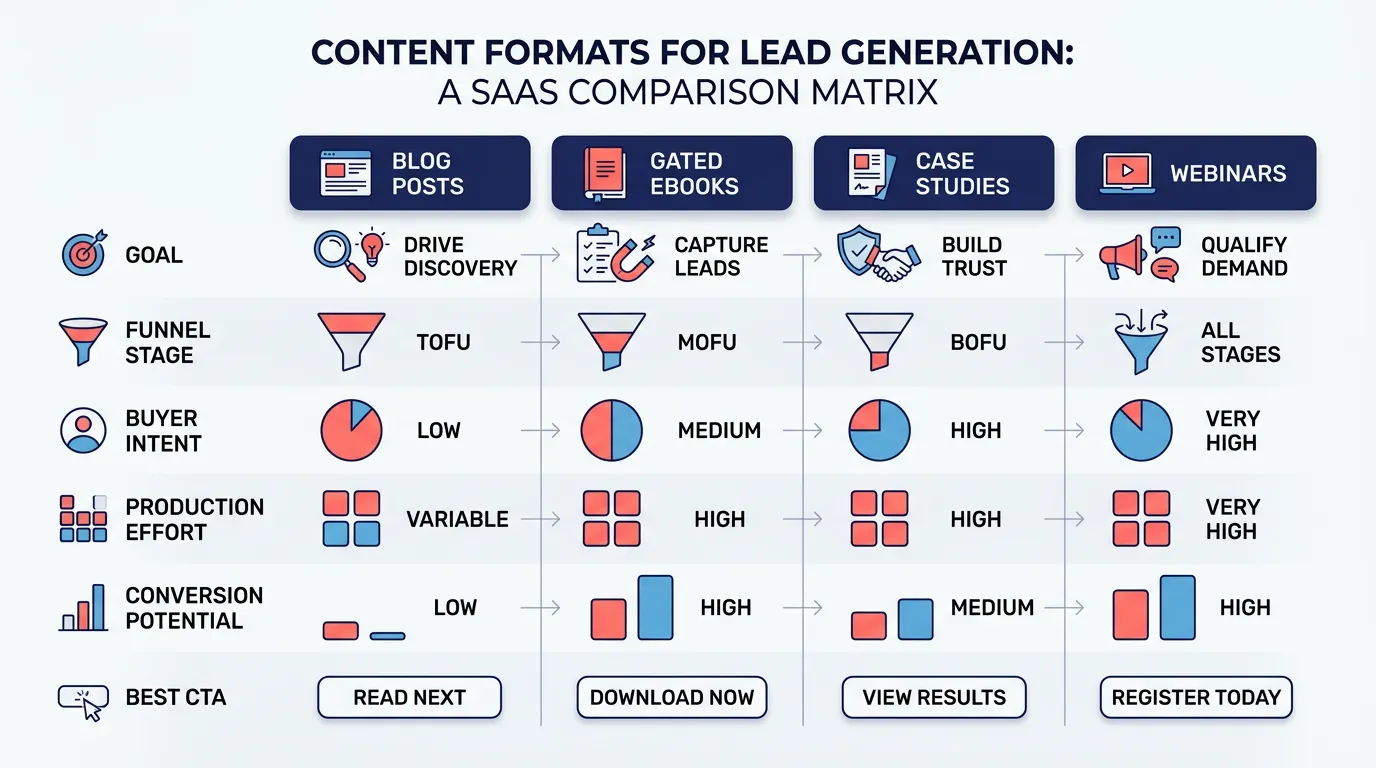
Here is a practical comparison of common lead generation content formats:
| Content format | Best funnel stage | Main goal | Conversion potential | Best CTA |
|---|---|---|---|---|
| Blog post | Awareness | Attract qualified traffic | Medium | Newsletter, template, related guide |
| Gated ebook or template | Consideration | Capture leads | High | Form submission |
| Case study | Decision | Build trust | High | Demo request |
| Webinar | Consideration to decision | Educate and qualify | High | Registration or meeting |
| Comparison page | Decision | Support evaluation | Very high | Trial or contact sales |
| ROI calculator | Decision | Quantify value | Very high | Demo or custom assessment |
How to optimize content for higher lead conversion
Build landing pages and forms that reduce friction
Even strong content underperforms if the conversion experience is weak. A landing page should make the value of the offer obvious, remove distractions, and ask only for the information you really need.
A few practical rules help:
- Match the landing page message to the content that referred the visitor
- Keep forms short unless the offer justifies more detail
- Use clear benefit-driven copy above the form
- Add trust signals such as testimonials, customer logos, or outcome-focused proof
- Test CTA language, form length, and page layout
Semrush highlights landing pages, social proof, form optimization, and SEO as important lead generation levers, which supports the idea that content performance depends on more than the article itself (Semrush).
Use internal links, SEO, and distribution to increase reach
Lead generation content should not live in isolation. Internal links move readers from education to consideration. SEO expands discovery. Distribution through email, social, communities, and partnerships helps each asset work harder.
That means every high-value article should point readers toward the next logical step. A top-of-funnel article can link to a template. A template thank-you page can link to a case study. A case study can link to a demo page.
Internal links also strengthen your site architecture. For example, readers interested in organic acquisition may also benefit from this guide on how to grow organic traffic, while teams tightening page-level performance can use this on-page SEO checklist to improve discoverability and conversion paths.
Track the metrics that show content is generating revenue
If you only track traffic, you will miss the point of a lead generation strategy. The right metrics tell you whether content is creating business value.
Focus on metrics such as:
- Organic sessions from target keywords
- Landing page conversion rate
- Leads generated by content asset
- Cost per lead by channel or topic cluster
- Sales-qualified leads influenced by content
- Pipeline and revenue influenced by content
This also lets you improve the roadmap over time. If one topic cluster drives visits but no conversions, you may need a better CTA or offer. If one webinar drives fewer leads but more pipeline, it may deserve more promotion than a blog series with vanity traffic.
Content strategy for lead generation example
Example strategy for a B2B SaaS company
Imagine a SaaS company selling workflow automation software to growth teams. Its audience includes heads of marketing and content leaders at mid-size B2B companies. The company wants more demo-qualified leads from organic search.
A practical strategy could look like this:
- Publish top-of-funnel articles around workflow problems, content operations, SEO scaling, and team productivity
- Offer downloadable templates tied to those topics, such as editorial calendars, content briefs, and KPI trackers
- Build middle-of-funnel guides comparing manual and automated workflows
- Publish case studies showing time savings and output gains
- Create bottom-of-funnel pages for use cases, integrations, and ROI conversations
That structure works because every stage connects logically. Traffic enters through educational content, subscribers convert through templates, qualified prospects move deeper through proof, and decision-ready buyers reach product-focused pages.
A simple 90-day lead generation content plan
Here is a straightforward example plan:
| Month | Focus | Content assets | Primary goal |
|---|---|---|---|
| Month 1 | Build awareness | 4 SEO blog posts, 1 template, 1 landing page | Attract qualified traffic |
| Month 2 | Capture demand | 3 blog posts, 1 webinar, 2 nurture emails | Increase lead volume |
| Month 3 | Convert demand | 2 case studies, 1 comparison page, 1 ROI page | Improve demo conversions |
This phased approach works well because it balances traffic generation with conversion assets. It also keeps your team from producing too much awareness content before the rest of the funnel exists.
Common mistakes to avoid as you scale
The most common mistakes are predictable:
- Publishing too much top-of-funnel content without enough offers
- Targeting high-volume keywords with weak buyer intent
- Sending all readers to the same CTA regardless of stage
- Treating blog performance and lead performance as separate systems
- Failing to update, repurpose, and improve content that already ranks
A good strategy is not just a library of articles. It is an operating model. It connects research, production, SEO, conversion design, and measurement into one repeatable process.
That is why many teams move from ad hoc publishing to a platform approach. Supawriter helps teams plan high-opportunity topics, produce long-form articles in brand voice, add contextual visuals, improve internal linking, and manage publishing workflows without stitching together disconnected tools.
If you are building a content strategy for lead generation in 2026, the approach is clear: match content to buyer intent, create offers that fit each stage, and measure success by leads and pipeline instead of traffic alone. Once that foundation is in place, your content stops being a cost center and starts contributing to growth. If you want to execute that system faster and more consistently, Supawriter is one option to explore.
Grow your traffic on autopilot now
Join thousands of users already using our platform.