On-Page SEO vs Off-Page SEO: Key Differences for 2026
supawriter
If you lead a SaaS company, you have probably heard the same SEO advice many times. Fix your pages. Build backlinks. Publish more content. The problem is that this advice rarely tells you what to prioritize first. In 2026, that matters more than ever because search results now mix classic blue links with AI-generated answers, rich results, and stronger brand signals. You need a clear framework for when to focus on on-page SEO, off-page SEO, and technical SEO, not a generic checklist. That kind of clarity is easier to build with Supawriter, which helps teams turn strategy, research, and SEO execution into a repeatable publishing system.
What is on-page SEO and what is off-page SEO?
On-page SEO definition
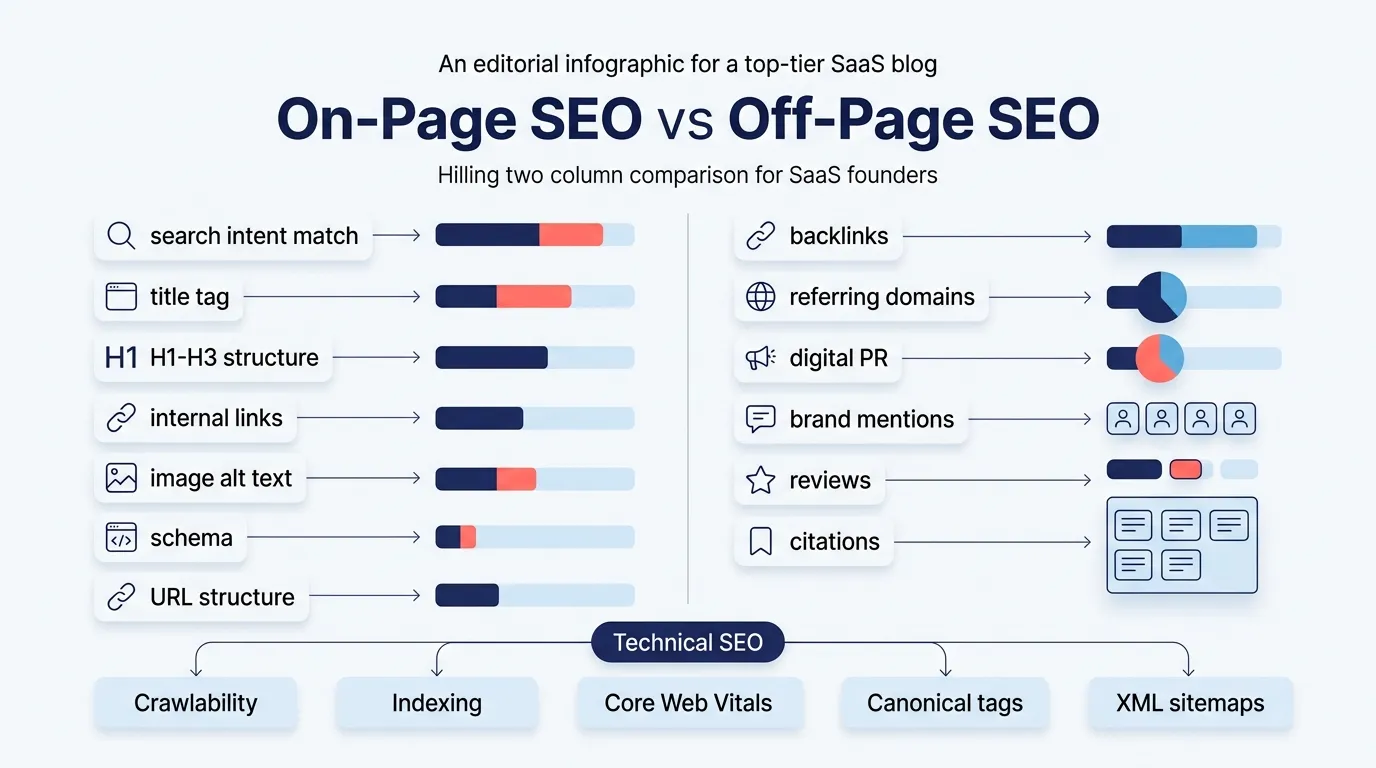
On-page SEO is the work you do on your own website to help a page rank. That includes the content itself, the title tag, headings, internal links, URL, images, and structured data. It also includes how well the page matches search intent.
If someone searches for "best CRM for startups," Google wants a page that clearly answers that query. A vague product page will struggle. A focused comparison page with strong structure, useful examples, and clear relevance has a better chance.
In simple terms, on-page SEO helps search engines understand what your page is about and helps users get what they came for.
Off-page SEO definition
Off-page SEO is the work that happens mostly outside your website to improve authority and trust. The clearest example is backlinks, which are links from other websites to your pages. But off-page SEO also includes brand mentions, digital PR, reviews, citations, and other signals that show your company is known and trusted.
Think of off-page SEO as reputation building. Your website can say you are an expert. Off-page signals show whether other sources agree.
Google still treats links as an important ranking signal, and Google's documentation says links can help its systems discover pages and understand which pages may be important.
How they work together
On-page SEO and off-page SEO support each other. Good on-page SEO gives search engines something worth ranking. Good off-page SEO gives them a reason to trust it.
If your content is weak, backlinks will not save it for long. If your content is strong but your site has no authority, it may not break into competitive search results. For most SaaS companies, rankings improve fastest when content quality, site structure, and authority growth move together.
This is one reason early-stage teams benefit from a systemized workflow. Supawriter helps you plan topics, create rank-ready content, improve internal linking, and keep publishing moving without turning SEO into a manual bottleneck.
On-page SEO factors you should optimize
Content quality and search intent
Content quality is the center of on-page SEO. Your page has to match what the searcher wants, not just repeat a keyword.
For SaaS founders, this usually means mapping each page to a specific stage of buyer intent:
- Educational searches, like "what is usage-based pricing"
- Comparison searches, like "Mixpanel vs Amplitude"
- Solution-aware searches, like "best customer support software for SaaS"
- Branded searches, like your company name plus "pricing" or "reviews"
Google's guidance on helpful content points in the same direction. Content should be created for people first, with clear value and original insight, not just to capture rankings.
That means your page should do a few things well:
- Answer the core question early
- Cover the topic with enough depth
- Use examples, screenshots, or data where useful
- Remove filler and repeated points
- Make the next step obvious
If you want a deeper process for this, see SEO content and this guide to building a content strategy.
Title tags, headings, and internal links
Once your content matches intent, structure matters.
Your title tag should make the page topic obvious. Your H2 and H3 headings should break the topic into logical sections. Your internal links should connect related pages so users and search engines can move through your site with context.
For example, if you publish a page about product-led onboarding, it should likely link to related pages about activation metrics, customer retention, or onboarding tools. This builds topical depth across the site.
Google recommends using descriptive link text and maintaining a logical internal linking structure so important pages are easier to find and understand.
Strong on-page structure usually includes:
- One clear primary topic per page
- A title tag that matches search intent
- An H1 that is close to the title
- H2s and H3s that reflect real subtopics
- Internal links to relevant supporting pages
- Metadata that improves click-through rate
If your team needs a repeatable process, this on-page SEO checklist is a useful companion.
Images, URLs, and schema
These details often get treated as minor tasks, but they shape how cleanly search engines process your pages.
Images should use descriptive file names and alt text when relevant. URLs should be short, readable, and stable. Schema markup can help search engines understand page type, organization details, products, reviews, FAQs, and more.
Structured data does not guarantee rich results, but Google states that valid structured data can make pages eligible for enhanced search features.
For SaaS companies, useful schema often includes:
- Organization schema
- Product schema
- Article schema
- FAQ schema, when content truly fits
- Breadcrumb schema
These are not substitutes for strong content. They can help strong content perform better.
Off-page SEO factors that influence rankings
Backlinks and link quality
Backlinks are still the clearest off-page SEO signal. But the number of links alone does not tell the full story. Link quality matters more than raw volume.
A few links from relevant, trusted sites in your category can help more than dozens of weak directory links. What you want is a healthy link profile built around real mentions, useful resources, original data, strong product pages, and content people actually cite.
Ahrefs has reported a relationship between the number of websites linking to a page and the search traffic that page tends to get, even though correlation does not prove direct causation.
For SaaS teams, the best link targets often include:
- Original research pages
- Free tools and templates
- Comparison content
- Category pages with unique positioning
- Thought leadership content with real data
If you are building this from scratch, start with this guide on how to earn backlinks.
Brand mentions and digital PR
Off-page SEO in 2026 is broader than outreach emails asking for links.
Brand mentions matter because search engines can connect your company name, product category, founders, reviews, and third-party coverage into a wider trust picture. If your company is regularly cited in industry content, quoted in media, included in partner ecosystems, and searched for by name, that usually supports stronger visibility over time.
Digital PR is one practical way to build these signals. That can include:
- Publishing original industry data
- Commenting on trends reporters cover
- Launching useful free tools
- Contributing expert insight to roundups
- Running campaigns people naturally reference
This is where content and off-page SEO overlap. A page that earns links usually has a reason to exist beyond ranking.
When it comes to turning research into assets worth citing, Supawriter can help. It lets teams move from keyword idea to finished article, visual support, and internal distribution faster, which makes digital PR easier to support with real content.
Reviews, social signals, and authority
Reviews, third-party listings, and broader authority signals can shape how trustworthy your company looks, especially for branded search, local intent, or category validation.
Social signals are not usually treated as direct ranking factors in a simple way, but social distribution can increase reach, attract links, and drive brand searches. Those second-order effects matter.
For B2B SaaS, authority signals often include:
- Reviews on software marketplaces
- Founder or company mentions on trusted sites
- Podcast appearances and guest articles
- Community mentions
- Partner ecosystem pages
- Consistent branded search demand
Off-page SEO works best when your company has something worth talking about and your site is ready to capture that demand.
On-page SEO vs off-page SEO: key differences
Control and effort required
The biggest difference is control.
On-page SEO is mostly under your control. You can rewrite a page today. You can improve headings, expand content, add schema, fix internal links, or update metadata without asking anyone else.
Off-page SEO is less direct. You can pitch reporters, run campaigns, and build relationships, but you cannot force another site to mention or link to you.
Here is the simple comparison:
| Area | On-page SEO | Off-page SEO |
|---|---|---|
| Where it happens | On your website | Outside your website |
| Main goal | Relevance and clarity | Authority and trust |
| Who controls it | Mostly your team | Other sites, audiences, media |
| Typical work | Content, titles, headings, links, schema | Backlinks, PR, reviews, mentions |
| Cost profile | Time and content ops | Time, outreach, PR, relationships |
This matters for SaaS founders because control affects speed. If you need near-term wins, on-page SEO is usually easier to start.
Speed of results
On-page SEO often shows results faster, especially if your site already has some authority and your pages are close to ranking. A better title tag, stronger search intent match, improved internal linking, or a more complete article can lift performance in weeks.
Off-page SEO usually takes longer. Earning links, coverage, and reputation is slower because it depends on external response.
That said, if your site is in a hard category like payroll software, security software, or sales automation, off-page SEO can become the gating factor. You may publish excellent content and still stall if stronger competitors have much deeper authority.
Impact on rankings and trust
On-page SEO has the strongest direct impact on topical relevance. It helps search engines decide what your page should rank for.
Off-page SEO has a stronger effect on comparative trust. It helps search engines decide whether your page deserves to outrank similar pages.
If two companies publish equally strong pages, the one with stronger authority, better backlinks, and broader brand recognition often wins.
That is why the real question is rarely "on-page SEO or off-page SEO?" The better question is "which one is the limiting factor for this site right now?"
Which matters more in 2026?
New websites vs established sites
For new websites, on-page SEO usually matters more first.
A young SaaS site often has three basic issues:
- Too little content
- Weak page targeting
- Thin internal linking
At that stage, building 50 backlinks to pages that do not match intent is wasteful. You need pages worth ranking before aggressive off-page work makes sense.
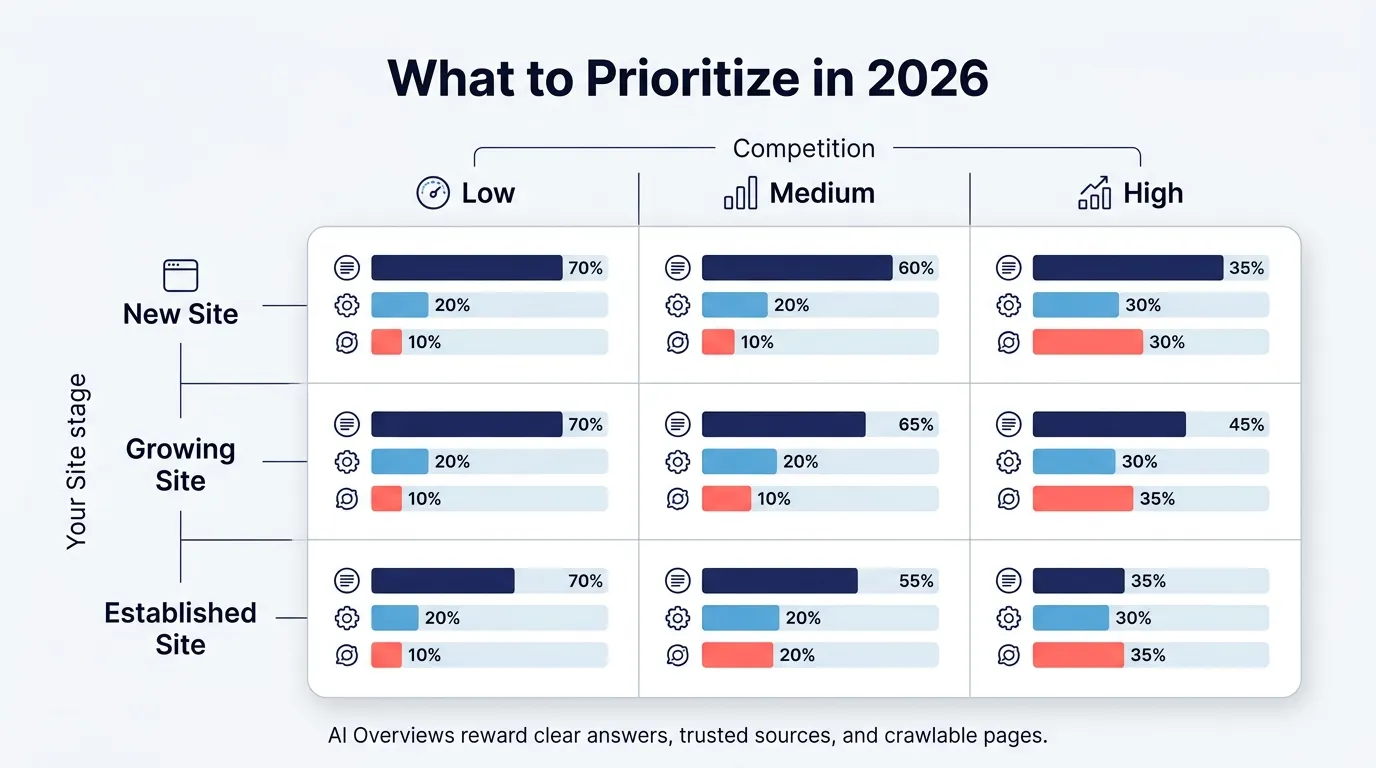
A practical rule:
- New site, low authority: prioritize on-page SEO and technical cleanup
- Growing site, some traction: keep improving on-page SEO, begin focused link building
- Established site: balance content refreshes, technical fixes, and authority growth
Competitive vs low-competition keywords
Keyword competition changes the answer.
For low-competition queries, strong on-page SEO can be enough. If your content is better structured, more current, and more useful than the alternatives, you can often rank without heavy off-page SEO.
For competitive terms, off-page SEO becomes much more important. Category pages, buyer-intent comparison pages, and high-value commercial keywords usually sit in SERPs dominated by sites with stronger backlink profiles and more established authority.
Use this framework:
| Situation | Priority |
|---|---|
| New site, low-competition topics | On-page SEO first |
| New site, competitive topics | On-page SEO plus selective link building |
| Established site, content underperforming | On-page refresh and internal links |
| Established site, close to page one | Off-page SEO to push authority |
| Any site with crawl/index issues | Technical SEO first |
This is also where AI-era search changes the playbook. Pages that earn visibility in AI summaries tend to have clear answers, strong structure, source-backed claims, and brand trust. Clean on-page SEO helps your content get understood. Off-page SEO helps your brand earn trust.
Technical SEO as the third pillar
Technical SEO is the third pillar, and many articles underplay it.
You can have strong content and good backlinks, but if your pages are hard to crawl, duplicate each other, load poorly, or fail to get indexed, rankings will lag.
Technical SEO includes:
- Crawlability
- Indexing control
- Canonical tags
- XML sitemaps
- Site speed
- Core Web Vitals
- Mobile usability
- JavaScript rendering issues
- Duplicate content management
For SaaS sites, technical issues often show up on template-heavy pages, knowledge bases, documentation hubs, faceted pages, and app-generated content.
If you are deciding where to start, technical SEO comes first when pages are not being indexed correctly, when site architecture blocks discovery, or when your templates create thin and duplicate pages at scale. For broader workflow planning, see this guide on automating SEO and this framework for keyword competitive analysis.
How to build a balanced SEO strategy
Step-by-step priority plan
A balanced SEO strategy starts with diagnosis, not tactics.
Use this order:
- Check technical health. Make sure important pages can be crawled, indexed, and loaded properly.
- Audit existing content. Find pages with impressions but weak rankings, pages ranking on page two, thin pages, and pages targeting the wrong intent.
- Improve on-page SEO. Rewrite weak intros, sharpen title tags, strengthen H2s, add internal links, improve visuals, and update schema.
- Map authority gaps. Compare your backlink profile and referring domains to the sites ranking above you.
- Run focused off-page campaigns. Build links to pages that already deserve to rank, not random pages.
- Track outcomes by page type. Separate blog performance, comparison page performance, feature page performance, and branded search performance.
For SaaS teams with limited bandwidth, this order helps avoid a common mistake, treating all SEO tasks as equal.
On-page and off-page SEO checklist
Here is a practical checklist you can use.
| On-page SEO checklist | Off-page SEO checklist |
|---|---|
| Match each page to one clear intent | Identify pages worth promoting |
| Improve title tag and meta description | Build links from relevant sites |
| Use clear H2 and H3 structure | Increase referring domains steadily |
| Add useful internal links | Pitch data and expert insights for PR |
| Optimize images and alt text | Monitor brand mentions |
| Keep URLs short and readable | Strengthen review profiles where relevant |
| Add appropriate schema | Build partner and ecosystem mentions |
| Refresh outdated content | Track link quality, not just count |
This is where a content engine helps. Supawriter lets teams move from SERP research to optimized drafts, internal links, visuals, and publishing in one workflow, which is useful when your SEO roadmap spans both on-page execution and off-page support.
Common mistakes to avoid
Most SEO programs do not fail because the team ignored SEO. They fail because the team spread effort across the wrong tasks.
Common mistakes include:
- Publishing content without a clear search intent
- Targeting keywords that are far too competitive for the site stage
- Building backlinks to weak pages
- Ignoring internal links
- Treating technical SEO as a one-time setup
- Using unnatural anchor text in link campaigns
- Letting old content decay
- Measuring success only by traffic, instead of pipeline or qualified visits
For founders, the key is simple. Build the page well. Make sure search engines can access it. Then build authority around the pages that matter most.
On-page SEO and off-page SEO are not competing choices. They are different levers. In 2026, the right priority depends on your site stage, keyword difficulty, and technical health. If your pages do not match intent, start with on-page SEO. If your content is strong but stuck below stronger domains, invest more in off-page SEO. If your site has crawl and indexing issues, fix technical SEO first. And if you want a faster way to turn that strategy into a real publishing system, explore Supawriter, which helps SaaS teams plan, write, optimize, and ship SEO content with less friction.
Grow your traffic on autopilot now
Join thousands of users already using our platform.